Los jóvenes involucrados tanto en los sistemas de bienestar infantil como de justicia juvenil —a veces denominados jóvenes cruzados, con doble participación, con doble fallo o de sistema dual— requieren un enfoque especial.1 Se necesita un enfoque intencional porque la participación en ambos sistemas está asociada con: mayores riesgos de problemas de salud mental, educativos y vocacionales; tasas más altas de reincidencia; estadías más prolongadas en detención; y peores resultados en cuanto a la estabilidad de las colocaciones y la permanencia.2
Desafortunadamente, la calidad y la consistencia de los servicios de trabajo social proporcionados a los jóvenes en la intersección de sistemas los dejan más vulnerables a la colocación en entornos restrictivos, como instalaciones grupales e institucionales, y sin actividades sólidas de planificación de permanencia vigentes.3 Los jóvenes que cruzan sistemas también requieren protección especial para salvaguardarlos de las consecuencias legales de una declaración de delincuencia. Dependiendo de la naturaleza del delito y de las leyes específicas de una jurisdicción, dicha declaración puede tener repercusiones negativas de por vida en las opciones de empleo y también en los resultados de bienestar infantil, lo que deja a estos jóvenes con menos opciones de colocación y apoyo.
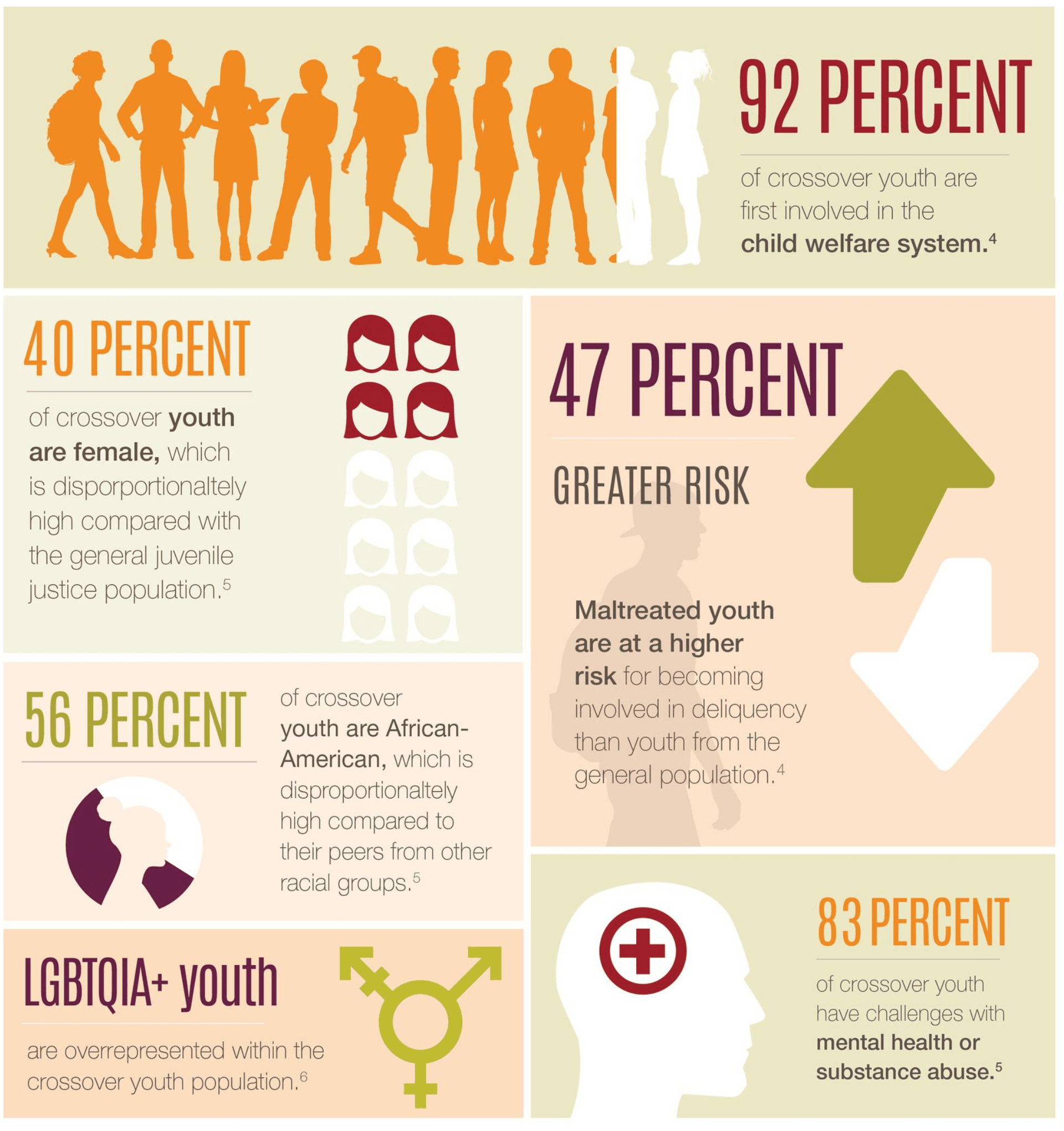
Datos sobre los jóvenes en la intersección del sistema4,5,6
En 2010, con el apoyo de Casey Family Programs, el Centro para la Reforma de la Justicia Juvenil de la Escuela de Políticas Públicas McCourt de la Universidad de Georgetown desarrolló el Modelo de práctica para jóvenes que cruzan sistemas (CYPM) para abordar las necesidades de los jóvenes en situación de tránsito. El CYPM es un modelo basado en fortalezas que se enfoca en la participación familiar y el trato equitativo en todos los niveles del sistema.
Se están llevando a cabo esfuerzos audaces en muchas jurisdicciones para transformar el sistema de justicia juvenil7 y crear alternativas que sean menos punitivas y más restaurativas. En muchos sistemas de protección infantil se están llevando a cabo iniciativas simultáneas para eliminar la necesidad de ubicaciones grupales. Si bien cambios transformadores como estos deberían conducir a una reducción en el número de jóvenes en situación de transición, es necesario adoptar un enfoque intersistémico deliberado para cada joven en riesgo de estar involucrado en dos sistemas.
Las investigaciones sugieren que la mejor manera de apoyar las necesidades de los jóvenes que atraviesan ambos sistemas es desarrollar un enfoque integral que involucre servicios integrados de múltiples sistemas, incluidos el bienestar infantil, la justicia juvenil, las fuerzas del orden, la educación, la salud conductual y los tribunales.8 La colaboración multisistémica es esencial y, como mínimo, debe incluir la gestión coordinada de casos, procesos de evaluación conjuntos, planes de casos coordinados y supervisión coordinada de casos. El CYPM proporciona una hoja de ruta para realizar cambios sistémicos que involucren a estos sistemas que atienden a los jóvenes.
La necesidad de un enfoque coordinado
A los 14 años, Evan9 fue arrestado y pasó los años restantes de su infancia involucrado tanto en los sistemas de justicia juvenil como de bienestar infantil. Dice que experimentó una falta total de coordinación entre ambos. Un oficial de correccionales juveniles, a quien Evan conoció muy rara vez y brevemente, tomó decisiones que determinaron el rumbo de su vida durante 10 años. Las recomendaciones de los profesionales de bienestar infantil y salud conductual que trabajaban con él, así como sus propias opiniones sobre sus necesidades y metas actuales y futuras, fueron ignoradas en su mayor parte, dice Evan.
Evan fue colocado en un centro institucional y no pudo asistir a la escuela pública. Esto a pesar de las múltiples recomendaciones del personal que mejor lo conocía y que interactuaba con él regularmente, quienes indicaban que había completado todos los cursos ofrecidos a través de su centro y que se aburría habitualmente. Se necesitó la defensa del personal del centro grupal y de salud mental y una orden judicial para permitirle finalmente asistir a algunas clases en la escuela pública. Sin embargo, después de terminar la preparatoria, Evan se vio obligado a recursar algunas clases cuando su oficial de corrección de menores perdió la documentación de sus créditos, dice Evan.
En última instancia, a pesar de que sus cargos se redujeron a delitos menores y de haber completado los cursos requeridos para convertirse en paramédico, a Evan se le negó una carrera en el campo médico debido a los cargos que enfrentó a los 14 años. Aun así, 11 años después de su primera audiencia judicial, Evan se considera afortunado. Ahora está empleado en un campo diferente, trabajando como defensor del cambio como becario Jim Casey Young Fellow de la Fundación Annie E. Casey. Él reconoce que muchos otros con experiencias similares se encuentran actualmente en prisión.
El modelo de práctica juvenil «Crossover»
Objetivos, valores, principios y temas
El CYPM incluye una variedad de programas basados en evidencia y mejores prácticas que tienen como objetivo alcanzar cuatro metas generales:
- Reducción segura del número de jóvenes colocados en cuidado fuera del hogar
- Reducción del uso de colocación en grupos e instituciones
- Reducción en el número de jóvenes que adquieren una doble participación en los sistemas de justicia juvenil y de bienestar infantil
- Reducción de la representación desproporcionada de los jóvenes de minorías étnicas, en particular en la población juvenil de transición
Todas las prácticas, políticas, programas, medidas de apoyo y servicios del CYPM se basan en los siguientes valores, principios y temas fundamentales:
- La juventud y las familias tienen fortalezas y deben ser tratados como individuos únicos.
- Los sistemas deben utilizar datos oportunos e integrados para tomar decisiones informadas sobre políticas y prácticas.
- Eficacia del personal es necesario fortalecer y el personal en todos los niveles debe recibir la capacitación y el apoyo adecuados para ampliar sus conocimientos sobre los jóvenes en situación de intersección y su capacidad para implementar el CYPM.
- Participación familiar significa construir relaciones de trabajo con las familias e incluir las voces de los jóvenes y las familias en toda toma de decisiones, planificación y trabajo de casos.
- Permanencia y la planificación de la transición es un enfoque clave y comienza al inicio del caso.
- Desproporcionalidad y las desigualdades son factores determinantes en la toma de decisiones, dado que los jóvenes de color, las mujeres y los jóvenes LGBTQIA+ están sobrerrepresentados entre los jóvenes en situación de transición.
- Compartiendo información entre los sistemas es fundamental y los problemas deben abordarse desde el principio y durante todo el caso.
- Alineación La prestación de servicios mediante la gestión coordinada de casos permite mejorar la eficacia en la prestación de los mismos y alcanzar objetivos comunes.
- Comprender, acceder y coordinación de recursos conduce a servicios más eficientes y eficaces.
Tres fases de la implementación de CYPM
El CYPM se divide en tres fases. Cada fase identifica políticas, programas y prácticas que mejorarán la manera en que una comunidad apoya a los jóvenes en situaciones de cruce entre sistemas.10 Se proporciona una lista completa de los elementos requeridos en The Crossover Youth Practice Model Abbreviated Guide.
PHASE I
During phase one, it is essential to bring together top-level leadership from participating agencies (at a minimum, presiding judge from the family court, chief probation officer/director of juvenile services, and the director of the child welfare agency). This team must be deeply committed to the model and actively involved in its implementation. Due to the complexity involved, an implementation team is also required. This team should include individuals representing the following organizations/populations: judiciary, juvenile justice, child welfare, education, mental health, substance abuse, youth, parents, law enforcement, attorneys, and Court Appointed Special Advocates (in smaller jurisdictions, communities may combine their leadership and implementation teams for efficiency). During this phase, jurisdictions should identify opportunities to prevent youth from being dually involved in the juvenile justice and child welfare systems. The first phase of the CYPM focuses on two areas:
- Arrest, identification, and detention: Studies indicate that crossover youth are detained more often and for longer periods than youth without child welfare involvement.11` Effective practice includes educating all professionals who work with crossover youth about the differences between youth involved with the child welfare system and their peers. This way, they become aware of the inequities and understand that they are being asked to treat the youth fairly, equitably, and individually and are not being asked to give crossover youth an unfair advantage. Identifying these young people at the point of crossover also enables collaboration at the earliest point possible.
- Decision-making regarding charges: Charging decisions can change a youth’s trajectory. Effective practice includes evaluating and exploring the possibility of changing the way charging decisions are made by working with prosecutors and defense attorneys to develop strategies around information-sharing so that parties making charging decisions have the benefit of the youth’s history and understanding of what led to the incident in question.
PHASE II
Once a youth becomes dually involved, joint assessments and coordinated case planning are required across systems. Policies and procedures need to be in place to support the coordination and communication between everyone involved in supporting the youth, including:
- Joint assessment and planning: The child welfare and juvenile justice caseworkers should immediately begin working together with the youth and his or her family. This includes minimizing the use of duplicative assessments and sharing information when permissible.
- Case assignment: Decision-making related to the case within and across systems must be coordinated. At a systemic level, this includes considering opportunities for dedicated crossover staff or point people for ease of communication and consistency.
- Court structures: Jurisdictions are strongly encouraged to use either a dedicated docket or a one judge/one family approach to improve coordination and handling of cases.
- Multi-disciplinary joint assessment process and coordinated case planning: A coordinated plan for the youth and his or her family or caregiver is developed by compiling information from across systems (including consideration of mental health, substance use, and educational needs) and holding family-centered interagency discussions based on this shared information. These discussions lead to the development of a coordinated case plan to guide coordinated case management services.
- Placement of crossover youth: Research has shown that placement in a group setting is a contributing factor to youth crossing over from child welfare to juvenile justice, and that such placements are generally not the most effective form of intervention for crossover youth.12 Youth who have been involved in the juvenile justice system often end up in group settings as their first out-of-home placement because of an arrest history. Jurisdictions must examine their use of group and institutional settings and placements and adopt best practices to achieve reduction. Jurisdictions should work with community providers to develop a flexible array of resources, such as family-based placements and placement with kin that respond to the needs and strengths of youth and families.
PHASE III
In this final phase, agencies coordinate an ongoing assessment of youth and family progress and jointly implement the case plan, making adjustments as needed. Additional activities include:
- Ongoing assessment of progress: Those involved in serving the youth and family (including, at a minimum, the child welfare and juvenile justice caseworkers, placement provider, community-based providers, school personnel, and kin) take an active role in determining the efficacy of the case plan and bringing any issues to the team for problem resolution.
- Planning for youth permanency, transition and case closure: Effective child welfare and juvenile justice caseworkers work collaboratively to support youth to achieve permanency and effectively transition upon case closure. This includes agencies providing ample notice to their partners when case closure is being considered.
- Permanency planning: Permanency planning begins at the onset of serving every youth and family. All practices supported by the practice model (such as permanency roundtables and benchmark conferences) aid in achieving the goal of family reunification.
Evidence to support the CYPM13
The Center for Juvenile Justice Reform at Georgetown University’s McCourt School of Public Policy has conducted internal evaluations on the CYPM and two other universities have conducted external research evaluations that have demonstrated the model’s efficacy. In recent years, the CYPM has been indicated as a “Promising Program” on multiple clearinghouses and registries, including the California Evidence Based Clearinghouse (2018) and U.S. Department of Justice’s Office of Justice Programs, National Institute of Justice (2020).
Results indicate that the CYPM is having a positive impact on identification, case management, and improved outcomes for crossover youth. Use of the CYPM led to early identification of crossover youth at significantly higher rates compared to those who received practice as usual. Involvement in extracurricular and structured activities, as well as contact with family and parents, also increased for youth who experienced the practice model. Additionally, when compared to crossover youth who did not experience the CYPM, youth involved in the practice model were:
- Slightly more likely to have their cases dismissed or receive diversion, and less likely to receive probation supervision or placement in corrections.
- Three times more likely to receive a promising practice, such as Cognitive Behavioral Therapy, Functional Family Therapy, or wraparound services.
- Less likely to live in group settings.
- Less likely to have Another Permanent Planned Living Arrangement as a permanency goal.
- More likely to have “remain at home” as a permanency goal.
- More likely to have one or both cases (child welfare and/or juvenile justice) closed.
- More likely to show improvements in mental health.
Jurisdictional implementation
As of 2022, more than 120 counties in 23 states have implemented or are in the process of implementing the CYPM, with training and technical assistance support from the Center for Juvenile Justice Reform. Select examples of jurisdictional experiences, outcomes, and lessons learned can be found in the following reports:
- Harris County, Texas, created a program for law students to build the unique skills needed to effectively serve crossover youth. Creating a legal workforce knowledgeable about the best ways to serve youth involved in both systems is essential to coordinating cross-system services.
- Eastern Idaho began fully implementing the CYPM in three counties in February 2020 after extensive planning with stakeholders. Pilot data gathered before and after implementation outline the demographics of crossover youth, differences in case processing and outcomes, and differences in social, behavioral health, and educational outcomes.
- Condado de Los Ángeles studied how many youth involved in the juvenile justice system were at some point previously involved in the child welfare system. The purpose of the study was to identify when additional supports may have helped strengthen the family and avoid future involvement with juvenile justice.
Casey Family Programs consulta con individuos y equipos en todo el país para recopilar investigaciones, experiencias y conocimientos sobre enfoques que pueden reducir de manera segura la necesidad de acogida familiar y garantizar el bienestar de los niños y las familias. Compartimos esta información ampliamente para ayudar a los líderes de bienestar infantil y a sus socios a abordar problemas similares en sus propias comunidades. Para preguntas sobre este recurso, o si tiene otras necesidades de información sobre bienestar infantil, envíe un correo electrónico a kmresources@casey.org.
1 Unless otherwise noted, information in this document was gathered from materials provided by the Center for Juvenile Justice Reform (https://cjjr.georgetown.edu/our-work/crossover-youth-practice-model/) and personal communication with Macon Stewart, Senior Program Manager, Center for Juvenile Justice Reform, December 20, 2017 and Alex Miller, Program Manager, Center for Juvenile Justice Reform, April 6, 2022. ↩︎
2 Caietti, C.M., Gaines, K., & Heldman, J. (2017). “Improving outcomes for dual status youth,” presented at the Beyond the Bench Conference, December 19, 2017. Retrieved from https://www.courts.ca.gov/documents/BTB24-2G-00PPT.pdf ↩︎
3 Annie E. Casey Foundation. (2013). NO PLACE FOR KIDS: The Case for Reducing Juvenile Incarceration. Obtenido de https://www.aecf.org/resources/no-place-for-kids-full-report ↩︎
4 Haight, W., Bidwell, L., Choi, W.S., & Cho, M. (2016). An evaluation of the Crossover Youth Practice Model (CYPM): Recidivism outcomes for maltreated youth involved in the juvenile justice system. Children and Youth Services Review, 6, 578-85. ↩︎
5 The Center for Juvenile Justice Reform, Georgetown University’s McCourt School of Public Policy. (2017). The Crossover Youth Practice Model: A Summary of Evaluations. ↩︎
6 Irvine, Angela Ph.D. and Canfield, Aisha M.P.P (2016). The Overrepresentation of Lesbian, Gay, Bisexual, Questioning, Gender Nonconforming and Transgender Youth Within the Child Welfare to Juvenile Justice Crossover Population. Journal of Gender, Social Policy & the Law, 24: (2), Article 2. Retrieved from https://digitalcommons.wcl.american.edu/jgspl/vol24/iss2/2 ↩︎
7 For more information about efforts to transform juvenile justice, please see the following resources:
Georgetown University, Transforming Juvenile Probation
Annie E. Casey Foundation, Juvenile Detention Alternatives Initiative
NCJFCJ, The Role of the Judge in Transforming Juvenile Justice (2021)
Urban Institute, Transforming Juvenile Probation (2021) ↩︎
8 Haight, W., Bidwell, L., Marshall, J.M., Khatiwoda, P. (2014) Implementing the Crossover Youth Practice Model in diverse contexts: Child welfare and juvenile justice professionals’ experiences of multisystem collaborations. Children and Youth Services Review, 39, 91-100. ↩︎
9 Conversation with Evan Davis on April 12, 2022 ↩︎
10 Aspects of the CYPM can be adapted for individual jurisdictions, however practices must be implemented with fidelity. ↩︎
11 Georgetown University McCourt School of Public Policy Center for Juvenile Justice Reform. (2015). The Crossover Youth Practice Model (CYPM): An Abbreviated Guide. Obtenido de https://drive.google.com/file/d/1lUXfhHxniknx5XctxJU3iBMW-eVDLcll/view ↩︎
12 Barth, R. P. (2002). Institutions vs. foster homes: The empirical base for the second century of debate. Retrieved from https://bettercarenetwork.org/sites/default/files/Institutions%20vs%20Foster%20Homes.pdf ↩︎
13 Research briefs and articles are available on the CJJR website: https://cjjr.georgetown.edu/resources/publications/ ↩︎