Las siguientes instantáneas jurisdiccionales destacan 12 modelos y enfoques estatales, de condado y nacionales diferentes para la capacitación del personal de las agencias de protección infantil. Para ver el análisis jurisdiccional complementario sobre este tema, consulte: ¿Cómo abordan el *coaching* algunas agencias de protección infantil?
Alabama
Programa de Becas del Título IV-E1
-
En el semestre de primavera de 2019, el Programa de Becas Title IV-E de la Universidad de Alabama puso en marcha un nuevo programa para ofrecer asesoramiento (coaching) a los estudiantes becados por Title IV-E. La primera cohorte incluyó a 15 estudiantes, de los cuales 13 se graduaron y ahora trabajan en la Oficina de Servicios de Protección Infantil del Departamento de Recursos Humanos (DHR) de Alabama. Cada semestre, a una nueva cohorte de estudiantes becados por Title IV-E se le ofrece la oportunidad de participar en el asesoramiento, el cual comienza mientras realizan su práctica profesional y continúa durante 18 meses después de la graduación, de modo que cada estudiante recibe aproximadamente dos años de asesoramiento.
-
El Programa de Becas del Título IV-E de Alabama utiliza un coaching de desarrollo modelo. A diferencia del entrenamiento de rendimiento, donde el entrenador enseña una técnica o habilidad específica, el enfoque principal del entrenamiento de desarrollo está en el individuo y lo que esa persona aporta al entorno laboral. El entrenador ayuda al miembro del personal con temas como habilidades de negociación, técnicas de autocuidado, confianza y comunicación. La relación entre el entrenador y el miembro del personal que recibe la capacitación es fundamental en este modelo, ya que el entrenador ayuda a las personas a descubrir cómo sus valores impactan su trabajo y las apoya para que usen sus valores en la fijación de su visión y metas. El entrenador brinda apoyo continuo y hace que las personas rindan cuentas de sus metas y de lo que quieren lograr.
Los coaches no ofrecen opiniones ni orientación sobre la práctica de casos específicos. Si el miembro del personal está pasando por un momento de inseguridad debido a un suceso difícil, la sesión de coaching se enfocará en procesar el trauma, reconocer los problemas y trabajar para seguir adelante, de modo que el miembro del personal pueda brindar un excelente servicio a la siguiente familia. La sesión de coaching no se centra en qué errores se cometieron en la evaluación ni en qué oportunidades se perdieron, ya que se espera que el personal acuda a su supervisor para recibir orientación sobre el trabajo de caso.
Los entrenadores deben brindar a los estudiantes dos horas de entrenamiento cada mes. Si bien se recomienda que los estudiantes completen dos sesiones de una hora cada mes, el modelo es flexible para permitir sesiones de dos horas si se adapta mejor a las necesidades del estudiante. Las sesiones de entrenamiento se completan cara a cara, o mediante video o teleconferencia.
-
El acompañamiento es un rol complementario para todos los entrenadores en este programa. La mayoría son trabajadores sociales o supervisores de bienestar infantil retirados, mientras que otros aún están empleados a tiempo completo en otros lugares. Los entrenadores no tienen una carga de casos fija, aunque la mayoría acompaña a dos o tres personas a la vez.
Los entrenadores certificados del Butler Institute for Families capacitan a los entrenadores. El plan de estudios se basa en la práctica; los módulos 70% a 80% se centran en la simulación de situaciones y en brindar retroalimentación a los compañeros. Esta experiencia práctica ayuda a los participantes a perfeccionar sus habilidades como entrenadores y a experimentar lo que es ser entrenado por otros. Después de la capacitación, los coaches participan en círculos de aprendizaje trimestrales a través de Zoom. Inicialmente, estos círculos eran moderados por los capacitadores del Butler Institute for Families, pero se han transformado en un grupo de apoyo y aprendizaje entre pares.
La capacitación incluye:
- Módulo uno: Capacitación presencial durante dos días de ocho horas.
- Módulo dos: Capacitación presencial durante tres días de ocho horas. Se lleva a cabo un mes después del Módulo uno.
- Seis meses de acompañamiento a un estudiante mientras participa en:
- Tres sesiones de coaching de una hora cada una en las que el nuevo coach recibe asesoramiento de uno de los capacitadores de Butler.
- Llamadas de conferencia mensuales de una hora con los entrenadores de Butler para recibir comentarios.
- Módulo tres: Capacitación presencial durante dos días de ocho horas.
-
Se están recopilando datos para una evaluación del programa que comparará los resultados de los estudiantes que reciben asesoramiento con los de otros graduados en trabajo social que trabajan en el DHR. La evaluación analizará la preparación laboral, la satisfacción laboral, la intención de permanecer en el puesto, la retención y los beneficios del asesoramiento. Se espera que los resultados iniciales estén disponibles en 2021.
-
Este programa de mentoría está financiado en su totalidad a través del Título IV-E.
California
Academia para la Excelencia Profesional2
-
La Academia para la Excelencia Profesional (también conocida como la Academia de Capacitación del Sur) comenzó a ofrecer asesoramiento en 2013 como resultado de la necesidad de apoyo de asesoramiento para los condados en relación con la Práctica Organizada para la Seguridad (SOP). Cuando la Academia comenzó con el asesoramiento, algunos de los condados a los que servía ya utilizaban el asesoramiento como una herramienta de gestión del desempeño. El personal de la Academia trabajó en estrecha colaboración con los directores y gerentes de los condados para cambiar la percepción del asesoramiento de modo que se viera como un apoyo y parte de una cultura de aprendizaje en lugar de un castigo.
Actualmente se ofrece coaching para el personal de apoyo, los asistentes sociales, los supervisores y los líderes. El tipo de coaching que se brinda a un condado se determina mediante una evaluación anual de necesidades que analiza todos los aspectos de la capacitación y el desarrollo del personal. Posteriormente, el condado y la Academia colaboran para elaborar un contrato que especifica quiénes recibirán coaching, en qué temas se les brindará y cuánto tiempo de coaching se requiere.
-
La Academy for Professional Excellence utiliza un modelo de asesoramiento basado en habilidades que proporciona acompañamiento en el trabajo para respaldar la aplicación de los conocimientos y las habilidades de la capacitación. En este modelo, el asesor y el miembro del personal forman un equipo que trabaja en conjunto para mejorar las habilidades o el desarrollo personal del empleado. Para cada sesión, el miembro del personal determina la habilidad o el objetivo que se explorará durante la sesión y, luego, el asesor y el miembro del personal recorren una serie de pasos estándar que incluyen identificar el interés inicial, establecer metas, observación y demostración, autorreflexión, retroalimentación, evaluación y planificación de acciones. Las sesiones de asesoramiento no se consideran una oportunidad de aprendizaje independiente, sino parte de un plan de desarrollo profesional más amplio.
El coaching también está integrado en todas las conversaciones entre el personal de la Academia y los líderes del condado. El personal de la Academia entrena a los líderes mientras brinda asistencia técnica y durante todas las conversaciones sobre el desarrollo de la fuerza laboral. La comunicación sobre el modelo de coaching y la demostración de sus beneficios para el personal y los líderes son una parte importante del modelo.
-
Los coaches se desempeñan tanto como capacitadores como coaches, lo que les permite vincular el programa de capacitación con las oportunidades de coaching. Hay un coach que se especializa en liderazgo, mientras que los demás brindan coaching a los asistentes sociales y a los supervisores.
Todos los nuevos entrenadores asisten a una capacitación sobre los fundamentos del entrenamiento para garantizar una comprensión básica del modelo de entrenamiento de la Academia. Se realiza una evaluación de necesidades para cada nuevo entrenador con el fin de evaluar los conocimientos sobre la práctica de bienestar infantil y las habilidades de entrenamiento de esa persona. Luego, la capacitación se personaliza para satisfacer las necesidades del nuevo entrenador, pero por lo general incluye observar las sesiones de entrenamiento individual y grupal de otros entrenadores, practicar el entrenamiento y completar registros de procesos de las sesiones de entrenamiento. Todos los entrenadores participan en supervisiones individuales y grupales, y asisten a reuniones semanales con el equipo de entrenamiento.
-
La Academia para la Excelencia Profesional utiliza Qualtrics para recopilar datos de los instructores y de los participantes en los cursos de capacitación. Cada instructor cuenta con un panel de control de datos para dar seguimiento a los resultados de la capacitación y ver los comentarios en tiempo real. Los directores de los condados reciben informes mensuales sobre la capacitación para que sepan cómo se utiliza y qué impacto tiene en su personal. Los datos incluyen la satisfacción con la experiencia de coaching, así como el número de horas de coaching, los objetivos de aprendizaje y el desarrollo de habilidades.
Los índices de satisfacción con el coaching son altos, lo que demuestra que el personal que ha recibido coaching se siente apoyado y permanece más tiempo en sus puestos de trabajo. Sin embargo, es difícil establecer una correlación entre los datos y los servicios que se están brindando (capacitación, simulaciones o coaching). El personal también afirma que el coaching les ayuda a sentirse más competentes y seguros de sí mismos.
-
El programa de entrenamiento se financia mediante contratos con el condado.
-
El personal de entrenamiento tuvo una transición fluida hacia un entorno virtual debido a que todos los entrenadores ya trabajaban a distancia, operando desde sus oficinas en casa y usando Zoom para conectarse entre sí. Mantener una comunicación sólida con los condados es importante para que entiendan que el entrenamiento sigue disponible y puedan identificar nuevas oportunidades de capacitación y entrenamiento.
California
Academia del Área de la Bahía3
-
Cuando se comenzó a ofrecer el coaching a través de la Academia del Área de la Bahía hace ocho o nueve años, estaba dirigido principalmente a los supervisores. Con el tiempo, el equipo reconoció que también se necesitaba coaching para los gerentes y el personal de primera línea a fin de cambiar eficazmente las prácticas y garantizar un lenguaje común en toda la organización. Como resultado, en 2020 se incorporó el coaching para estos grupos. La Academia ofrece coaching en diversos formatos, incluyendo coaching individual y grupal.
Los entrenadores de la Academia también capacitan a los supervisores y gerentes para que entrenen a su personal. La Academia ofrece un curso de tres días llamado “El arte de entrenar” como parte de la capacitación central para supervisores, y una capacitación de un día para gerentes.
-
La Bay Area Academy utiliza un enfoque de entrenamiento centrado en la persona y basado en habilidades. Los entrenadores apoyan a las personas a explorar dónde los sesgos, las suposiciones, la resistencia y las expectativas impactan su trabajo con las familias o los colegas. El entrenamiento se considera una herramienta valiosa para desarrollar la capacidad de la fuerza laboral con el fin de ayudar a mejorar las habilidades, transferir el aprendizaje a la práctica y mejorar el rendimiento.
El objetivo es integrar el coaching en todas las áreas de la práctica a través de cinco servicios integrales:
- Coaching individual se lleva a cabo para apoyar el crecimiento y desarrollo profesional y personal de un individuo.
- Coaching grupal Es un tipo de coaching temático dirigido a un grupo con el fin de fomentar una mayor comprensión de los contenidos y/o el proceso, así como el desarrollo de conocimientos especializados.
- Entrenamiento en campo mejora la transferencia del aprendizaje del aula a la aplicación en el trabajo, y ofrece oportunidades para el crecimiento y el desarrollo profesional en el momento.
- Entrenamiento basado en habilidades se enfoca en mejorar una habilidad o un conjunto de habilidades, como la Toma de Decisiones Estructuradas y la Práctica Organizada para la Seguridad. El coach se centra principalmente en la tarea, la herramienta o la habilidad (el “hacer” en lugar del “ser”). El coach apoya a la persona para que adquiera competencia en la práctica, las herramientas o los conceptos mediante la observación y la provisión de retroalimentación inmediata.
- Enfoque integral del coaching apoya a las personas a desarrollar capacidad en sí mismas y en sus habilidades prácticas. Los entrenadores se centran tanto en el “ser” como en el “hacer” del coaching.
A los condados se les ofrece la gama completa de servicios y trabajan con el equipo de la Academia para desarrollar un contrato de asesoramiento que incluya los servicios que satisfagan sus necesidades únicas.
-
Algunos de los instructores son entrenadores certificados, mientras que otros están en el proceso de certificarse. Todos los entrenadores asisten a la capacitación Art of Coaching y luego son observados mientras entrenan e imparten la capacitación. La mayoría de los entrenadores son contratados debido a su amplia experiencia en capacitación.
-
No existe una evaluación sólida del programa de asesoramiento. Los asesores utilizan rúbricas con el personal para evaluar el progreso, pero estos datos no se analizan de forma agregada. En las sesiones de retroalimentación, los supervisores afirman que se sienten respaldados en su puesto y existe evidencia anecdótica de que el asesoramiento ha dado lugar a la retención de supervisores.
-
El programa de entrenamiento se financia mediante contratos con el condado.
-
La Academia del Área de la Bahía está en el proceso de trasladar el plan de estudios de asesoramiento de un formato presencial a uno en línea. El asesoramiento se está llevando a cabo tanto por videoconferencia como por teléfono, según el nivel de comodidad del miembro del personal. No está claro si el asesoramiento a distancia continuará después de que pase la pandemia. Sin embargo, de manera anecdótica, el asesoramiento a distancia parece ser más exitoso de lo previsto.
California
Academia de Capacitación del Centro de California4
-
La Central California Training Academy comenzó a utilizar el coaching en relación con la implementación del modelo de práctica en 2012. Un equipo de apoyo a la implementación ofrece coaching en dos niveles: (1) a nivel de sistema para el liderazgo a nivel de condado; y (2) basado en habilidades para los trabajadores de casos de primera línea y sus supervisores.
-
Todo el acompañamiento (coaching) proporcionado a través de la Academia de Capacitación del Centro de California se ofrece en el contexto de la implementación y comienza con el liderazgo. Para que un condado reciba apoyo de acompañamiento, debe haber algo hacia lo cual el liderazgo esté orientando (como el Modelo de Práctica Central, la Práctica Organizada para la Seguridad u otras prácticas). Los gerentes, directores y sus equipos reciben acompañamiento sobre liderazgo adaptativo, creación y fomento de asociaciones, uso de datos y ejecución de cambios. Los trabajadores sociales y supervisores reciben acompañamiento basado en habilidades relacionado con la Práctica Organizada para la Seguridad, el Modelo de Práctica Central y la transferencia del aprendizaje de la capacitación básica.
El modelo de coaching dicta que cada sesión de coaching tiene cuatro elementos: (1) compromiso y establecimiento de metas; (2) modelo y demostración; (3) retroalimentación; y (4) próximos pasos. El personal tendrá tanto una meta para la sesión como una meta continua que se esfuerza por lograr.
-
La Academia cuenta con un equipo de ocho a 10 entrenadores que son miembros del equipo de apoyo a la implementación. La capacitación para los entrenadores se imparte a través de una asociación con la Universidad de Carolina del Norte en Chapel Hill. No existen proporciones fijas entre entrenadores y personal de campo para los entrenadores basados en el terreno.
-
El programa de mentoría no ha sido evaluado como un programa independiente. Se observa a través de la lente de la ciencia de la implementación, que incluye a la mentoría como un conductor esencial para la implementación exitosa de nuevas prácticas. Los comentarios recopilados sobre las sesiones de asesoramiento individual indican que el asesoramiento es muy valorado, pero no hay datos que puedan vincular el asesoramiento con los resultados de la práctica de casos o la retención del personal.
-
El entrenamiento se financia a través del Instituto de Políticas para la Infancia y la Familia de California, contratos del condado y el contrato maestro de la Academia.
-
El entrenamiento remoto se proporciona al personal que trabaja de forma virtual, y el equipo se está volviendo competente en Zoom.
California
Departamento de Servicios para Niños y Familias del Condado de Los Ángeles5
-
El coaching se utilizó por primera vez hace 10 años en el condado de Los Ángeles en relación con la implementación del Modelo de Práctica Básica, y ha evolucionado con el tiempo. Desde 2017, el coaching se ha vuelto más estructurado y consistente.
Se ofrece coaching a todos los trabajadores sociales y supervisores. El equipo de coaching tiene como meta que al menos el 70% de cada oficina reciba coaching. Para alcanzar este objetivo, el personal de coaching se comunica diariamente con los supervisores y los trabajadores sociales para identificar necesidades y brindar ayuda adicional en una habilidad específica, o para determinar si una unidad necesita capacitación o coaching relacionado con los comportamientos de práctica.
-
El condado de Los Ángeles no utiliza un modelo de asesoramiento identificado. El condado ha adoptado un proceso de certificación para ayudar al personal a facilitar reuniones de calidad con las familias, y los asesores (coaches) brindan asesoramiento basado en habilidades en áreas tales como la forma de involucrar a las familias mediante el trabajo en equipo y la evaluación, en relación con los 23 comportamientos de práctica del Modelo de Práctica Básica. En el pasado, el asesoramiento era diferente en cada oficina, pero ahora se identifican temas anuales y cada oficina recibe las mismas oportunidades de asesoramiento y capacitación. El asesoramiento incluye un proceso de observación, demostración y retroalimentación.
También se espera que los supervisores sean entrenadores y apoyen a sus trabajadores de casos durante todo el proceso de certificación. Los formadores de entrenadores ayudan a los supervisores a certificarse para entrenar a su personal.
-
Hay 13 formadores de entrenadores que trabajan a través de la oficina de la agencia principal del condado, y cada oficina local también tiene uno o dos propios. Los entrenadores aprenden mediante capacitación en el aula, experiencia práctica en el trabajo y autoformación. Los formadores de entrenadores asistieron a una academia de entrenamiento de tres días a través del Consejo Nacional sobre el Delito y la Delincuencia (National Council on Crime and Delinquency). También participan en mesas redondas mensuales para apoyo entre pares y desarrollo profesional. Recientemente se añadió un módulo de entrenamiento a la capacitación básica de supervisores, lo cual refuerza la idea del entrenamiento como parte de las responsabilidades de un supervisor.
-
No hay una evaluación formal del programa de coaching. Hay una evaluación de los resultados de la práctica, pero no están conectados con la participación en el coaching.
-
El programa de entrenamiento se financia a través del presupuesto del condado.
-
Los entrenadores han experimentado algunos desafíos con las plataformas virtuales. Si bien el personal y los entrenadores cuentan con plataformas de videoconferencia compatibles, las familias no tienen el mismo acceso a la tecnología, lo que dificulta que los entrenadores observen a los trabajadores de casos practicar sus habilidades y luego brindar retroalimentación. El entrenamiento virtual basado en habilidades todavía se lleva a cabo entre los entrenadores y el personal para apoyar el desarrollo profesional de los trabajadores de casos.
California
Academia de Capacitación del Norte de California6
-
Cuando la Northern California Training Academy comenzó a ofrecer entrenamiento a las agencias de protección infantil en 2008, fue la primera academia en California en hacerlo. En ese momento, no existía investigación sobre el entrenamiento en protección infantil. Tras una revisión de los modelos y estrategias de entrenamiento, la Northern California Training Academy seleccionó un modelo basado en habilidades, el cual cuenta con evidencia que demuestra su éxito en ayudar a los profesionales a aprender nuevas habilidades. El entrenamiento basado en habilidades se utiliza más típicamente en entornos educativos K-12, modelos de entrenamiento para padres y otros modelos que tienen la fidelidad como objetivo (por ejemplo, la Entrevista Motivacional).
Se ofrece entrenamiento tanto a los trabajadores de casos como a los supervisores en forma de entrenamiento individual y grupal. El entrenamiento individual se ofrece a los supervisores inscritos en programas de capacitación (Capacitación Básica para Supervisores y Herramientas para la Excelencia en la Supervisión) y consta de cuatro a seis sesiones mensuales de entrenamiento personalizado. A los gerentes de programas y directores vinculados a los programas de capacitación en liderazgo también se les ofrece entrenamiento individual, mientras que el entrenamiento grupal se utiliza con más frecuencia para implementar la Práctica Organizada de Seguridad. Se asignan entrenadores a un condado y ofrecerán sesiones grupales para una combinación de trabajadores nuevos y experimentados. Además del entrenamiento, los entrenadores de la Academia también ofrecen un instituto de capacitación en entrenamiento para desarrollar la capacidad de entrenamiento de supervisores, gerentes y directores, de modo que puedan utilizar habilidades de entrenamiento con sus equipos. También ofrecen capacitación en entrenamiento a los líderes de los condados durante todo el año para ayudarles a construir una cultura de entrenamiento en sus organizaciones.
-
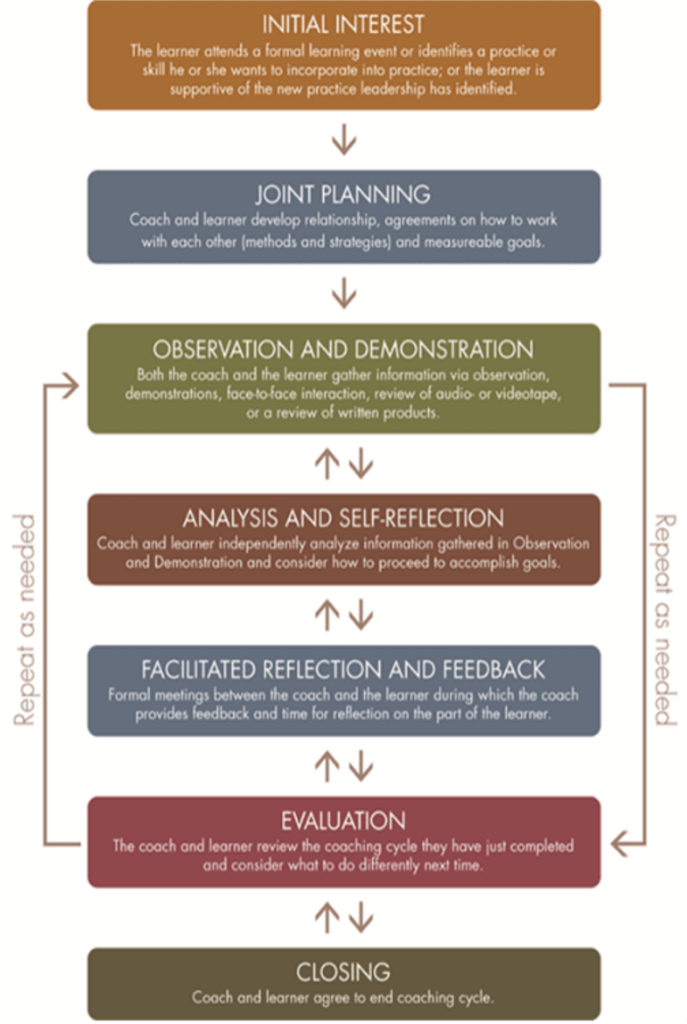
El modelo de entrenamiento basado en habilidades es un proceso de siete pasos que incluye un ciclo de observaciones y demostraciones. Los siete pasos son: (1) interés inicial; (2) planificación conjunta; (3) observación y demostración; (4) análisis y autorreflexión; (5) reflexión facilitada y retroalimentación; (6) evaluación; y (7) cierre. Los pasos del 3 al 6 se pueden repetir tantas veces como sea necesario y algunos de los pasos pueden ocurrir simultáneamente. La observación y la demostración permiten que el personal realice las habilidades que está intentando aprender e integrar, y que el entrenador proporcione retroalimentación para que puedan reflexionar sobre ella.
-
Los cinco instructores que conforman el equipo no son empleados de tiempo completo, aunque se les utiliza regularmente para la instrucción. Los líderes de la academia también son instructores capacitados. Algunos de los instructores son expertos en liderazgo y brindan la capacitación Herramientas para la Excelencia a gerentes y directores cada dos años, y a los supervisores durante los años alternos. No hay una cantidad de casos establecida para los instructores, pero por lo general son responsables de hasta 10 personas y cuatro condados.
-
El personal de la Academia completa una retrospectiva anual con los condados para recopilar información de los gerentes de nivel ejecutivo sobre cómo el entrenamiento ha impactado la práctica y cómo las cosas serían diferentes si su condado no hubiera recibido entrenamiento. También se entregan encuestas a los entrenadores y al personal, pero la tasa de respuesta es baja.
Durante el último año, se llevaron a cabo grupos focales y entrevistas como parte de una evaluación de asesoramiento respaldada por Casey Family Programs. Esta evaluación encontró que los condados que eran nuevos en el asesoramiento (menos de dos años) tenían comentarios entusiastas y positivos sobre su experiencia de asesoramiento, pero la satisfacción disminuyó después de dos años. El análisis muestra que los condados se sintieron más apoyados durante las fases iniciales de asesoramiento, pero cuando el asesoramiento se convirtió en un servicio continuo, ya no se reconoció como algo especial.
La evidencia indica que los condados con asesoramiento de Práctica Organizada para la Seguridad (SOP) han implementado SOP de manera más sólida que aquellos que no utilizaron asesoramiento. Por ejemplo, los condados que implementaron SOP sin asesoramiento no están colaborando en equipo con los clientes y están menos enfocados en la participación.
No hay datos actuales que conecten el asesoramiento con la retención de los trabajadores sociales de casos. Una evaluación del primer programa de asesoramiento, Tools for Supervisory Excellence, en 2009 y 2010 mostró que el personal que recibió asesoramiento permaneció en la agencia por más tiempo y tuvo más probabilidades de ser ascendido.
-
El entrenamiento se financia a través de contratos de los condados y el contrato maestro de la Academia con el Departamento de Servicios Sociales de California.
Colorado
Departamento de Servicios Humanos del Condado de Arapahoe7
-
En 2013, el condado de Arapahoe fue uno de los primeros condados de Colorado en desarrollar un programa de asesoramiento. El asesoramiento se ofrece a los nuevos trabajadores sociales de casos y comienza mientras cursan su capacitación de certificación inicial de 12 semanas. No se exige que los nuevos trabajadores sociales de casos acepten el asesoramiento y no hay una duración prescrita para la relación de asesoramiento. El número de horas de asesoramiento también varía y depende del miembro del personal. En promedio, los nuevos trabajadores sociales de casos pasan entre cinco y 10 horas con su asesor en el campo. Los trabajadores sociales de casos experimentados también reúnen los requisitos para recibir asesoramiento y es posible que solo necesiten una o dos horas con un asesor para trabajar en una habilidad o meta específica identificada. También se ofrecen asesoramiento grupal y laboratorios de práctica para abordar las necesidades técnicas del personal, como la realización de trámites.
Los supervisores reciben asesoramiento por parte del supervisor de capacitación y asesoramiento para el desarrollo profesional, quien es un colega. Esta relación de asesoramiento ayuda a fomentar el apoyo al asesoramiento por parte de los supervisores y aumenta la comprensión de cómo difieren los roles y las responsabilidades de los supervisores y los asesores.
-
Cuando comenzó, el programa de asesoramiento en el condado de Arapahoe se basaba en el Kit de herramientas de coaching de la Universidad de California en Davis. Más recientemente, los entrenadores han completado el Coaches College del Kempe Center, que se basa en Co-Active modelo de *coaching*. Como existen pocos modelos de *coaching* específicos para la protección infantil, el programa de *coaching* del condado de Arapahoe ha adoptado un enfoque diverso, recurriendo a estas y otras fuentes para satisfacer las necesidades del personal y del condado. No existe un modelo oficial del condado.
El coaching está conectado directamente con la capacitación de los nuevos trabajadores de casos. Todos los nuevos trabajadores de casos se reúnen con el supervisor de capacitación y coaching de desarrollo profesional, quien los asigna a un coach. La asignación se basa en la carga de trabajo de los coaches, así como en las fortalezas y necesidades tanto del coach como del trabajador de casos. El coach y el nuevo trabajador de casos se reunirán para hablar sobre el programa, comprender los beneficios y sentar las bases para una relación de coaching. Después de unas semanas, el trabajador de casos y el coach completan una herramienta de evaluación de preparación para el coaching, lo que les ayuda a decidir si el trabajador de casos necesita un coach y cuáles serán sus objetivos. Los trabajadores de casos completan simulaciones prácticas con sus coaches, y sus objetivos de coaching están vinculados a las habilidades que desean mejorar, según el plan de estudios de capacitación. Los coaches saben qué se está enseñando en la capacitación y cómo debería verse en la práctica. Los coaches utilizan una herramienta de desarrollo profesional que complementa el modelo de práctica.
Los nuevos trabajadores de casos también son asignados a un mentor líder de aprendizaje que trabaja dentro de su área (pero en un equipo diferente) y está disponible para brindar apoyo diario. Los nuevos trabajadores de casos acompañan a su mentor para aprender cómo aplicar prácticas específicas a diario. El capacitador, el mentor y el supervisor forman un equipo de “apoyo integral” para que el nuevo trabajador de casos pueda sentirse totalmente respaldado.
-
El condado de Arapahoe contó inicialmente con un personal de dos entrenadores de práctica de tiempo completo, lo que ha evolucionado a un equipo de cuatro entrenadores de desarrollo profesional de tiempo completo. Los entrenadores se clasifican como “trabajadores sociales C”, que es el nivel más alto de trabajador social. No llevan casos, pero los puestos requieren experiencia en la gestión de casos de bienestar infantil. Los entrenadores no están especializados y brindan asesoramiento tanto para trabajadores sociales de admisión como de seguimiento. Cada entrenador tiene una carga de trabajo de 16 a 20 trabajadores sociales. La proporción ideal es de 12 a 15 miembros del personal por entrenador.
Los nuevos entrenadores son contratados en función de su experiencia y conjunto de habilidades. Pasan un tiempo acompañando a sus colegas para aprender el proceso. También asisten a la Universidad de Entrenadores y leen el libro de entrenamiento Co-Active. Los entrenadores reciben supervisión quincenal para apoyar su desarrollo profesional continuo.
-
En 2018, el condado de Arapahoe completó una evaluación de su programa mediante una encuesta a todo el personal nuevo y a todos los supervisores cuyos subordinados recibían coaching. La encuesta se utilizó para identificar brechas en el aprendizaje y para reunir al equipo a fin de definir los siguientes pasos. Entre los asistentes sociales, 70% señaló que el coaching les ayudó a permanecer en el puesto. Además, cada miembro del personal completa una evaluación al finalizar el coaching. Las respuestas muestran que los trabajadores sociales valoran el coaching y lo consideran útil para prepararse para su trabajo.
-
Los puestos de entrenador están totalmente financiados por el presupuesto interno del condado de Arapahoe.
Colorado
Sistema de capacitación en bienestar infantil del Centro Kempe8
-
Colorado comenzó a utilizar el *coaching* como estrategia en 2013. Si bien algunos condados ofrecen *coaching* a los trabajadores de casos, este programa a nivel estatal enfoca su *coaching* individual y de sistemas en los líderes dentro del bienestar infantil. Si bien a nadie se le impide participar en el *coaching* debido a su rol o cargo, el Sistema de Capacitación en Bienestar Infantil adopta este enfoque debido al gran impacto que los líderes pueden tener en las experiencias individuales de los trabajadores de casos, la dinámica de los equipos y el funcionamiento organizacional general. El *coaching* de sistemas también se ofrece a equipos y organizaciones para trabajar en temas como la fomento de la cohesión, el aumento de la confianza y el desarrollo de mayor valentía al examinar cuestiones relacionadas con la diversidad, la equidad y la inclusión. Todo el *coaching* a través del Sistema de Capacitación en Bienestar Infantil es voluntario.
-
Colorado estructuró inicialmente su programa de entrenamiento utilizando el Universidad de California, Davis modelo y luego evolucionó a Co-Active modelo. En el Co-Active El modelo y los entrenadores se enfocan en la persona como un todo, en lugar de centrarse únicamente en su desafío específico. Los entrenadores no tienen un rol de capacitación, por lo que se abstienen de ofrecer consejos o dar dirección. El Sistema de Capacitación para el Bienestar Infantil, mediante el uso del modelo Co-Activo, trabaja hacia la transformación en los individuos y los sistemas. Como tal, el programa no trata de que el entrenador tenga respuestas para la persona que está siendo entrenada. En su lugar, un principio fundamental del modelo es que el personal es naturalmente creativo, recursivo e íntegro. La persona que recibe el entrenamiento crea y diseña el enfoque para este, y el entrenador y el miembro del personal cocrean conjuntamente cómo el trabajo que realizarán juntos apoyará de la mejor manera a dicha persona. Este modelo de entrenamiento permite que los individuos y los equipos encuentren el equilibrio entre el ser y el hacer. Les brinda más espacio para el ser, de modo que puedan ser reflexivos sobre cómo están haciendo el trabajo. La modalidad de entrenamiento se determina en función de varios factores e incluye opciones presenciales, por teléfono o mediante Zoom.
-
Los entrenadores deben tener experiencia previa en bienestar infantil y un sólido entendimiento de los principios y la dinámica del liderazgo. Se realizan esfuerzos para asignar entrenadores a condados fuera de donde trabajaron anteriormente. La mayoría de los entrenadores también tienen funciones, independientes de la capacitación, que incluyen la formación y el desarrollo de planes de estudio. La carga máxima de casos de aquellos para quienes el entrenamiento es su única responsabilidad es de 10 personas y dos o tres equipos. Aquellos con responsabilidades mixtas tienen un máximo de cuatro personas y dos equipos.
El Co-Active Institute capacita a todos los entrenadores, y cualquier persona que proporcione entrenamiento en sistemas también debe completar el programa de Entrenamiento en Sistemas de Organización y Relaciones (ORSC) a través de CRR Global. Además, hay tres facilitadores certificados de Dare to Lead™ en el equipo del Sistema de Capacitación en Bienestar Infantil. Se han unido a aproximadamente 30 entrenadores de varios condados de Colorado para participar en una colaboración de entrenamiento que se reúne mensualmente, tanto de manera presencial como virtual, para el desarrollo de habilidades, consulta y apoyo.
-
El programa fue evaluado recientemente por el Centro de Evaluación de la Universidad de Colorado mediante un enfoque de teoría fundamentada, el cual encontró que los 19 participantes del estudio se sintieron positivos acerca de sus experiencias de mentoría, informando una mayor confianza, nuevas perspectivas y comportamientos, y mejores habilidades relacionadas con el trabajo en equipo, el liderazgo y la toma de decisiones. La dirección de The Kempe Center consideró que las respuestas de los participantes se alineaban con los objetivos del programa en múltiples áreas. Los hallazgos de la evaluación se utilizarán para dar forma a la mejora continua de la calidad y garantizar que el programa siga cumpliendo con los resultados previstos.
-
El programa de asesoramiento se financia a través de una subvención estatal de capacitación para la cual The Kempe Center es la organización de gestión central.
Colorado
Servicios Humanos del Condado de Jefferson9
-
Si bien el asesoramiento en el condado de Jefferson comenzó inicialmente en 2013, terminó unos años más tarde debido a cambios de personal. Un programa de asesoramiento se reinició en 2018 y continúa hoy en día. Los asesores están disponibles para el nuevo personal durante su primer año, pero no hay una duración fija para la relación de asesoramiento, y el tiempo de duración está determinado por las necesidades de la persona del personal que recibe la asesoría. Al principio, el asesoramiento era obligatorio para los nuevos trabajadores de casos, pero esto demostró ser ineficaz. Ahora, los asesores se reúnen con cada nuevo trabajador de casos después de la certificación para ver si tienen objetivos que les gustaría abordar. Los asesores son hábiles para propiciar oportunidades de asesoramiento y objetivos de los trabajadores de casos, y la mayoría acepta la oportunidad de participar. La idea del asesoramiento se retoma más tarde con aquellos que rechazan el acercamiento inicial. El personal experimentado también puede acceder al asesoramiento para apoyar sus objetivos de desarrollo profesional (como prepararse para oportunidades de ascenso).
-
El coaching está completamente dirigido por el gestor de casos. Co-Active proporciona la base para el entrenamiento en el condado de Jefferson, pero se ve más como un enfoque que como un modelo, ya que no fue escrito específicamente para una agencia gubernamental de protección infantil.
-
El programa de entrenamiento del condado de Jefferson cuenta con dos entrenadores de práctica: uno que entrena a los trabajadores sociales de permanencia y otro que entrena a los trabajadores sociales de admisión. El entrenamiento es un puesto de tiempo completo, equivalente a un trabajador social principal. Los entrenadores deben tener experiencia como trabajador social y solo el personal interno es elegible para postularse a este puesto.
Si bien los programas de entrenamiento de Jefferson son impulsados enteramente por el condado, sin supervisión formal del estado, este proporciona capacitación en el entrenamiento Co-Active a través del Coaches College del Kempe Center. Esto incluye tres días de capacitación presencial y de seis a ocho semanas de reuniones con otros entrenadores para realizar prácticas de entrenamiento entre pares a través de Zoom. El último paso antes de la certificación es una sesión de entrenamiento simulada a través de Zoom en la que el nuevo entrenador recibe comentarios del personal de capacitación estatal.
El desarrollo profesional continuo para los entrenadores a nivel de condado incluye la supervisión por parte de su supervisor y la provisión de apoyo entre colegas. Los entrenadores reciben supervisión semanal que se alterna entre supervisión individual y grupal. Los entrenadores también participan en un centro de colaboración a nivel estatal, el cual ofrece un foro trimestral para que los entrenadores de condados de todo el estado participen en supervisiones grupales y consultas.
No existe una proporción fija de entrenadores por miembro del personal en el condado de Jefferson, y las cargas de trabajo se ajustan según las necesidades de los entrenadores y los trabajadores sociales. La carga de trabajo depende de las tasas de rotación y contratación. No se ha establecido un estándar de casos para los entrenadores.
-
El programa de asesoramiento lleva menos de dos años en funcionamiento, por lo que hay muy pocos datos para demostrar los resultados. Los trabajadores de casos reciben una encuesta después de seis meses de asesoramiento y al final de su experiencia de asesoramiento. Los datos preliminares de estas encuestas muestran que los trabajadores de casos disfrutan de ser asesorados y están aprendiendo de sus asesores, y que aprecian la experiencia y quieren que el programa continúe.
-
Los entrenadores son personal del condado y sus salarios provienen de la misma fuente de financiamiento que otros trabajadores de casos.
Ohio
Programa de Capacitación en Bienestar Infantil10
-
El entrenamiento para trabajadores de casos y supervisores en Ohio comenzó en 2010, y el entrenamiento para directores ejecutivos y familias de recursos comenzó unos años después. El entrenamiento se ofrece a trabajadores de casos, supervisores, familias de recursos, directores ejecutivos y administradores para ayudar a desarrollar las habilidades prioritarias identificadas durante las evaluaciones de necesidades estatales, de los condados e individuales. No es obligatorio y nunca se utiliza como parte de un plan de disciplina progresiva. El Centro de Capacitación Regional de Ohio evalúa las solicitudes de entrenamiento para determinar la mejor manera de satisfacer la necesidad. Hay algunos casos en los que la capacitación sería más eficaz que el entrenamiento, o en los que la solicitud no es apropiada para el entrenamiento. Una vez que se identifica el enfoque del entrenamiento, se empareja a la persona con un entrenador que esté certificado en el conjunto de habilidades solicitado.
-
El entrenamiento del personal y de las familias de recursos se basa en habilidades, tiene un tiempo limitado y está conectado directamente con el de Ohio Universo de competencias en bienestar infantil. El modelo de coaching se basa en fortalezas. Los coaches elaboran un plan de coaching con la persona y el supervisor de dicha persona. El plan incluye:
- Enfoque del coaching (áreas de habilidades y competencias).
- Comportamientos de práctica deseados para el individuo y el supervisor para apoyar al individuo durante el entrenamiento.
- Pasos de acción para adquirir las habilidades o competencias deseadas.
El individuo y el supervisor asignan una calificación que mejor describa el comportamiento actual. Cuando el proceso de mentoría concluye, regresan a esta calificación y proporcionan una calificación “posterior” para cada comportamiento con el fin de determinar el progreso y establecer los próximos pasos.
El entrenamiento para el personal puede incluir habilidades como la participación de las familias, la realización de visitas domiciliarias, el trabajo con parientes y familias extensas, el uso del modelo estructurado de evaluación y apoyo a la toma de decisiones de Ohio, la planificación de casos y la documentación de casos. El entrenamiento para los cuidadores incluye habilidades como el cuidado de bebés con síndrome de abstinencia neonatal, la gestión de conductas relacionadas con el trauma y el trabajo con los padres. El entrenamiento ejecutivo se ofrece a través de una asociación con la Asociación de Servicios Públicos para la Infancia de Ohio (Public Children’s Services Association of Ohio), donde los directores y administradores reciben entrenamiento en habilidades que incluyen gestión fiscal, visión, planificación estratégica y liderazgo.
-
El Centro de Capacitación en Bienestar Infantil de Ohio ya contaba con un sistema de contratistas independientes para toda la capacitación, el cual se amplió en 2010 para incluir a los instructores de bienestar (*coaches*). Todos los capacitadores e instructores pasan por un proceso de certificación y aprobación como capacitadores fundamentales. Una persona puede optar por ser capacitador, instructor o ambos. Por lo general, los instructores llegan al puesto con experiencia en la práctica de protección infantil o salud mental. Todos los instructores asisten a una capacitación para instructores que se enfoca en las funciones y responsabilidades, además de abordar y practicar habilidades clave de instrucción. No existe una proporción fija entre instructor y miembro del personal. La mayoría de los instructores tienen otro empleo, por lo que no pueden asesorar a más de cuatro personas a la vez.
-
El coaching se evalúa en múltiples momentos del proceso. Las evaluaciones de seguimiento se completan cuando el coaching está en curso. Una vez concluido el coaching, tanto el individuo como el supervisor reciben encuestas de evaluación. Estos datos de encuesta se utilizan para evaluar el progreso individual. Sin embargo, debido a la falta de automatización, los datos no se agregan para evaluar la efectividad general del programa. Los testimonios de los participantes expresan el valor de la experiencia, pero no hay evidencia de que el coaching esté vinculado a la retención. El impacto del coaching para familias de acogida es más evidente cuando se mantiene la colocación y el niño no es trasladado a una nueva familia.
-
El coaching se financia principalmente a través de fondos de capacitación del Título IV-E. El contrato estatal incluye una combinación de fondos que incluye el Título XX, el Título IV-B y la CAPTA.
Pensilvania
Oficina de Niños, Jovenes y Familias del Condado de Allegheny11
-
El entrenamiento (coaching) en el condado de Allegheny se introdujo por primera vez en 2013, simultáneamente a la implementación de un nuevo modelo de práctica por parte del condado. Los entrenadores eran expertos en la materia sobre el modelo de práctica y trabajaban con todos los supervisores y trabajadores de casos para ayudarles a aprender el modelo y aplicar los principios en su práctica de casos. Una vez completada la implementación del modelo de práctica, el entrenamiento se convirtió en un servicio ofrecido a los trabajadores de casos recién contratados, a quienes se les exige trabajar con un entrenador para aprender el modelo de práctica.
La mayor parte del entrenamiento se lleva a cabo en el terreno, y solo 25% se realizan en la oficina. Los entrenadores modelan comportamientos prácticos con las familias mientras el miembro del personal observa, y luego explican qué hicieron, cómo lo hicieron y por qué. Estas conversaciones ayudan a los nuevos asistentes sociales a relacionar lo que están aprendiendo en el aula con su trabajo en el terreno. A medida que los nuevos trabajadores sociales se sienten más cómodos con los comportamientos prácticos, asumen una mayor parte de la práctica, mientras que el mentor observa y brinda retroalimentación sobre su desempeño. No existe un plazo obligatorio para el entrenamiento de los nuevos trabajadores sociales, pero la mayoría alcanza la competencia entre cinco meses y un año después de comenzar el entrenamiento. Los entrenadores también están disponibles para cualquier otro trabajador social o supervisor que esté interesado en recibir este servicio.
-
El entrenamiento en el condado de Allegheny es una combinación de modelos que incluye CRECER (Metas, Realidad, Opciones y Voluntad), OSCAR (Resultado, Situación, Opciones, Acciones y Revisión), y BORRAR (Contract, Listen, Explore, Action y Review). Cuando el coaching se inició en 2013, se consideraba orientado a procesos, y los coaches pares actuaban como expertos en la materia que se asociaban con el personal con el propósito de transferir su experiencia. El programa de coaching ha evolucionado para incluir aspectos de Teoría del cambio intencional como una forma de ayudar a los entrenadores a centrarse en el desarrollo personal y profesional integral de la persona que recibe el entrenamiento. El coaching es ahora una oportunidad para apoyar a la fuerza laboral de una manera impulsada por el individuo, lo cual es más significativo que si fuera impulsado por la agencia.
Componentes principales del modelo de coaching:
- ContractualLos entrenadores establecen un contrato con cada una de las personas a las que entrenan. Este acuerdo de trabajo sienta las bases para la relación de entrenamiento y permite establecer expectativas y aclarar los roles tanto para el entrenador como para el miembro del personal. El proceso de contratación ayuda a descubrir qué tipo de aprendiz es el miembro del personal y a determinar cómo se darán y recibirán los comentarios. El contrato también incluye información sobre lo que el miembro del personal quiere obtener del entrenamiento y qué hará que valga la pena.
- ReflexivoEl coaching ofrece tiempo para una reflexión profunda. Todos los comentarios se basan en el reconocimiento de que el aprendizaje ocurre no solo al practicar una habilidad, sino al reflexionar sobre la acción. En una sesión de coaching, el personal puede reflexionar sobre qué fue fácil, qué fue difícil, cuándo se sintió seguro y cuándo no se sintió seguro. El miembro del personal identifica qué funcionó bien y, al mismo tiempo, aprovecha y reconoce qué fue complicado y qué se podría hacer de manera diferente la próxima vez.
- Basado en fortalezasLos entrenadores están capacitados para ser observadores y astutos ante las fortalezas obvias del individuo, así como aquellas que están bajo la superficie. Ayudan al personal a identificar lo que están haciendo bien, lo cual a menudo no es evidente para ellos.
- Senfocado en solucionesEl entrenamiento enfocado en soluciones es paralelo a la práctica enfocada en soluciones con familias. Los entrenadores utilizan preguntas para ayudar al personal a pensar en una situación similar en la que experimentaron un resultado positivo. A continuación, se le pide al personal que nombre e identifique qué contribuyó a ese resultado favorable.
- CuriosoLos entrenadores poseen una curiosidad auténtica por la persona que tienen enfrente. Los entrenadores están capacitados para formular preguntas reflexivas para mantener la conversación de mentoría en marcha con el fin de llegar a las causas raíz.
- Centrado en la personaLos entrenadores dejan de lado su propia agenda y se enfocan en las necesidades de la persona que recibe el entrenamiento. La interacción de entrenamiento se centra en lo que el miembro del personal necesita, y no en las necesidades del entrenador o de la agencia.
-
Los instructores son promovidos desde puestos de primera línea. El programa actual apoya a ocho instructores que son responsables del personal en cinco oficinas regionales. No hay una proporción fija entre instructor y miembro del personal. Se asigna uno o dos instructores a cada oficina regional y las asignaciones de instrucción se realizan de forma rotativa. A los nuevos instructores se les proporciona información sobre los componentes principales del modelo de instrucción y reciben instrucción en su rol por parte del gerente de la unidad.
-
El programa de acompañamiento no ha sido evaluado, pero el gerente del programa se encuentra en las primeras etapas de creación a un panel de datos de acompañamiento que incluirá información sobre los temas que los acompañantes solicitan, los niveles de satisfacción de los trabajadores sociales con su experiencia de acompañamiento y datos de retención.
-
El programa de asesoramiento se financió inicialmente a través de una subvención en bloque estatal que también respaldó la implementación del nuevo modelo de práctica. No está claro de dónde proviene el financiamiento actual, pero parece ser la misma fuente de financiamiento que otros puestos de trabajo social y de supervisión.
Pensilvania
Departamento de Servicios Humanos de Filadelfia12
-
El coaching en Filadelfia comenzó en 2013 cuando el Departamento de Servicios Humanos inició Mejorando los resultados para los niños, un modelo para la prestación de servicios de bienestar infantil, justicia juvenil y prevención del maltrato infantil. Este modelo requirió que los trabajadores sociales en las agencias comunitarias paraguas (CUA) asumieran nuevas responsabilidades de gestión de casos (como la redacción de planes de casos, evaluaciones de seguridad y evaluaciones de riesgo). Los entrenadores son considerados expertos en la materia y brindan capacitación y asistencia técnica en las CUA.
Los nuevos trabajadores de casos de CUA reciben la capacitación y certificación del estado de Pensilvania a través de la Universidad del Departamento de Servicios Humanos de Filadelfia. Se proporciona acompañamiento (coaching) como complemento de la capacitación para ayudar a los nuevos trabajadores de casos a aplicar lo que aprenden en la capacitación a su práctica en el campo. El acompañamiento está disponible mientras están en capacitación o puede comenzar después de que esta finalice, según las habilidades y necesidades del nuevo trabajador de casos. Los facilitadores también ofrecen sesiones informativas y sesiones formales de capacitación grupal, según sea necesario. Los temas para estas sesiones se obtienen de las revisiones trimestrales de expedientes de casos y de las solicitudes de los supervisores y trabajadores de casos.
-
No hay un modelo definido de entrenamiento. Los entrenadores tienen responsabilidades que van desde impartir sesiones formales de capacitación e información hasta consultas individuales, reuniones de equipos y revisiones de casos.
-
Los entrenadores son empleados de la Universidad del Departamento de Servicios Humanos de Filadelfia (anteriormente Desarrollo de Personal) y brindan servicios en las seis CUA contratadas. Cada CUA cuenta con entre 45 y 55 trabajadores sociales, y un entrenador y un supervisor (para el entrenador) se encuentran en cada CUA. El supervisor del entrenador está disponible para brindar capacitación a los supervisores en la CUA, mientras que el entrenador brinda capacitación a los trabajadores sociales. No existe una proporción fija de entrenadores por miembro del personal, pero se expresó que la proporción de personal preferida es de dos entrenadores de práctica por cada CUA.
Los entrenadores de práctica reciben capacitación en competencia de instructores por parte de Centro de Recursos de Bienestar Infantil de Pensilvania, donde reciben capacitación fundamental sobre cómo ser formadores y entrenadores. La capacitación abarca temas como: habilidades de facilitación y consultoría; desarrollo organizacional; inteligencia emocional; gestión de proyectos; y creación de planes de estudio. Después de la capacitación, los entrenadores acompañan a otros entrenadores en cada una de las CUA para poder comprender la cultura única de cada agencia.
-
El programa de asesoramiento no está siendo evaluado y no se recopilan datos sobre cuántos nuevos trabajadores sociales reciben asesoramiento ni cuánta capacitación brindan los asesores. Datos de Tarjetas de puntuación CUA demostrar que la práctica ha mejorado desde el inicio del entrenamiento, pero no hay información que conecte directamente el entrenamiento con estas mejoras en la práctica.
-
El entrenamiento se financia a través del presupuesto de Filadelfia. Es posible que algunas de las actividades sean reembolsables a través del Título IV-E.
Casey Family Programs consulta con individuos y equipos en todo el país para recopilar investigaciones, experiencias y conocimientos sobre enfoques que pueden reducir de manera segura la necesidad de acogida familiar y garantizar el bienestar de los niños y las familias. Compartimos esta información ampliamente para ayudar a los líderes de bienestar infantil y a sus socios a abordar problemas similares en sus propias comunidades. Para preguntas sobre este recurso, o si tiene otras necesidades de información sobre bienestar infantil, envíe un correo electrónico a kmresources@casey.org.
1 La información de esta sección se recopiló a partir de una comunicación personal con Kristy Holt, coordinadora del Título IV-E, y Melody Denton, coordinadora del Programa de Becas IV-E, de la Universidad de Alabama, el 13 de marzo de 2020. ↩︎
2 La información de esta sección se recopiló a partir del informe del Programa de Consultores de Práctica de Servicios de Desarrollo para el Bienestar Infantil (Child Welfare Development Services Practice Consultant Program) y de la comunicación personal con Jennifer AhSing y Dawn Schoonhoven Scott, de la Academia para la Excelencia Profesional (Academy for Professional Excellence), el 19 de mayo de 2020. ↩︎
3 La información de esta sección se recopiló a partir del Esquema del plan de prestación de servicios de asesoramiento de Bay Area Academy y de la comunicación personal con Gloria King, capacitadora y asesora de Bay Area Academy, el 7 de mayo de 2020. ↩︎
4 La información de esta sección se recopiló a partir de una comunicación personal con Andrea Sobrado, entrenadora y consultora de la Academia de Capacitación de California Central, el 7 de mayo de 2020. ↩︎
5 La información de esta sección se recopiló a partir de una comunicación personal con Dorothy Byron-Arrington y Blanca Bonilla, del Departamento de Servicios para Niños y Familias del Condado de Los Ángeles, el 29 de mayo de 2020. ↩︎
6 La información de esta sección se recopiló a partir de una comunicación personal con Nancy Hafer y Alison Book, de la Northern California Training Academy, el 12 de mayo de 2020. ↩︎
7 La información de esta sección fue recopilada a partir de comunicación personal con Stacia Schmied-Johnston, supervisora de capacitación y asesoramiento para el desarrollo profesional, del Departamento de Servicios Humanos del condado de Arapahoe, el 24 de febrero de 2020. ↩︎
8 La información de esta sección se recopiló a partir de comunicaciones personales con Ashley Anderson, gerenta de capacitación, y Kasey Matz, directora de proyectos, del Centro Kempe para la Prevención y el Tratamiento del Abuso y Descuido Infantil (The Kempe Center for the Prevention and Treatment of Child Abuse & Neglect) y del Sistema de Bienestar Infantil de Colorado (Colorado Child Welfare Training System), el 2 de marzo de 2020. ↩︎
9 La información de esta sección se recopiló a partir de una comunicación personal con Elizabeth (Liz) Huffman, supervisora de entrenadores de práctica de Servicios Humanos del Condado de Jefferson, el 14 de febrero de 2020. ↩︎
La información de esta sección se obtuvo de comunicación personal con el personal del Ohio Institute for Human Services, el 5 de marzo de 2020. ↩︎
11 La información de esta sección se recopiló a partir de una comunicación personal con Greg Phillips, gerente del Instituto de Trabajo en Equipo del Departamento de Servicios Humanos del condado de Allegheny, Oficina de Niños, Jóvenes y Familias, el 29 de enero de 2020 y el 21 de febrero de 2020. ↩︎
12 La información de esta sección se recopiló a partir de una comunicación personal con Robin Chapolini, directora de aprendizaje; Taheerah Long, administradora de capacitación y entrega, y Luciana Terrell, directora de desarrollo organizacional y profesional, del Departamento de Servicios Humanos de Filadelfia, el 21 de febrero de 2020. ↩︎