Summary
New York City’s efforts use seven levers for change: examining research and data, looking at funding and policy, engaging those with lived expertise, shifting mindsets, engaging cross-system partners, developing training and tools for mandated reporters, and designing pathways for family support.
Child protection agencies, people with lived experience in the child welfare system, community partners, and advocates around the country are using data and research to explore practices and policies that help to ensure child safety while keeping families safely together. Mandated reporting, as currently designed, is a well-intentioned but often overused and misused practice that can inflict harm and compound trauma on children and families, diverting critical system resources away from those who need them the most.
A range of strategies to transform mandated reporting are being designed and tested across the U.S., with the goal to design better alternatives than child protection hotlines to serve as entry points for supporting families in need. These alternatives, which include helplines and community pathways, offer prevention-based support to families that have been identified to be in crisis but are in situations that do not rise to the level of initiating a child protection investigation.
The New York City Administration for Children’s Services (ACS) and many of its partners have put forth an effort to transform mandated reporting1 that includes reaching tens of thousands of reporters through training in the education, health and social service sectors.
Several catalysts propelled ACS toward this transformation:
- Advocacy efforts inside and outside the agency, including from people with lived experience in the child welfare system.
- The recognition of harm caused by unwarranted child protection investigations, in particular the disproportionate impact of such investigations on families of color.
- Using data to inform on mandated reporting trends, including volume and patterns of reports.
These catalysts — combined with a 2021 law that required updated training for mandated reporters — positioned ACS to begin working on multiple fronts — and benefit from New York City’s already strong foundation of community services focused on preventing family crises.
This brief is organized around seven key levers for transforming mandated reporting that evolved out of a December 2024 Casey Family Programs-sponsored convening on mandated reporting that child protection agency leaders and lived experts attended:
- Start with and routinely examine trends and research
- Engage people with lived expertise
- Examine existing funding and policy approaches
- Develop reporter awareness, education, training, and tools
- Build a new narrative and shift mindsets
- Engage cross-system partners
- Design better pathways for families to access support
Start with and routinely examine trends and research
This was about racial disproportionality and the sheer scale of investigations.
Examining research and data trends was a critical early step in transforming mandated reporting in New York City.2 Exploring and disaggregating data allowed ACS to understand the scope of the problem and who was most affected, and more recently, has allowed for insights into the impacts of its efforts. In 2024, 78% of New York City’s 51,467 child protection responses (40,144) did not result in a finding of abuse or maltreatment. Investigation disparities were striking:
- Black children were 8 times more likely than white children to be in an investigation.
- Latino children were 7 times more likely than white children to be in an investigation.
- Recent research estimated 44% of Black children in New York City experience a child protection investigation before age 18.
Engage people with lived expertise
If you are thinking about updating mandated reporter training in your state, please partner with parents who have navigated the system. Their experience makes a big difference.
Lived experts have played an important role in transformation efforts in New York City. Historically, advocates through the court system have helped shape and inform parents’ legal rights. That advocacy evolved to include a focus on narrowing the front door of the child welfare system and influencing changes to mandated reporting. While more work is to be done in this area, ACS currently engages people with lived experience in this effort by:
- Partnering with parent advocacy groups including Rise and the ACS Parent Advocacy Council. These and other groups provide feedback, support impacted families, and shape ACS’s approach to mandated reporting, including the way it trains staff across the city.
- Requiring providers to engage with lived experts to improve community services. Prevention providers funded by ACS participated in a training and were given a toolkit aimed at strengthening the engagement of lived experts in their work. Rise has been instrumental in helping providers include family perspectives in their work, including the use of peers to provide direct support to families. “If there was peer support or somebody I could trust who wasn’t a mandated reporter, I would have asked for help,” said Shakira Paige, a peer trainer for Rise.
- Establishing new positions and programs to support ACS staff and impacted parents. A prevention parent advisor position is being developed, and a new Parent Connectors program is designed to help parents navigate the prevention services system. ACS also is adding a lived expert to its leadership team.
Examine existing funding and policy approaches
The state legislature enacted reforms in 2020 and 2021 that helped to catalyze mandated reporting transformation in New York City. Parent coalitions and legal aid organizations pushed for this reform and ACS supported the changes. In April 2020, a new law raised the standard of evidence needed to indicate a report of child abuse or neglect from “some credible evidence” to a “fair preponderance of the evidence.”
In 2021, spurred by a growing focus on racial disproportionality, the legislature enacted a law requiring that the New York State Office of Children and Family Services update its mandated reporter training to include an implicit bias component and material on adverse childhood experiences (ACEs). These changes emerged in part from an ACS proposal that mandated reporters participate in the same implicit bias training that child protection specialists were receiving.
The updated training also clarifies legal requirements for reporting, helping mandated reporters better understand when they are legally required to call the child protection hotline. A shift in messaging from “When in doubt, call the hotline” to “You can support a family without having to report a family” has been critical in enabling transformation, as it serves to remind mandated reporters that they have alternatives to reporting families when safety needs do not warrant it.
Develop reporter awareness, education, training, and tools
During the training, we talk about the data showing African-American families being eight times more likely to have a report. That has been a catalyst, coupled with talking about the continuum of services available and mandated reporters knowing there is this arm of support.
The 2021 state law ushered in changes to mandated reporter training. Informed by multiple working groups that included parents, educators, health care staff, and other stakeholders, statewide training was updated to:
- Ensure reporting decisions are not based on fear of legal consequences for failing to report.
- Recognize and mitigate the impact of bias in decision-making.
- Emphasize that poverty in and of itself is not child maltreatment.
- Use a trauma-informed, ACEs-aware approach that emphasizes protective factors.
- Promote sound decision-making through consults with colleagues, focusing on objective facts, and working through a decision tree that will help the reporter understand if the situation meets the legal definition of abuse and maltreatment.
The updated training — provided in English and Spanish and continuously accessible — includes nine interactive modules with scenarios and quizzes to test knowledge (users cannot advance until they complete each module by passing a true/false quiz), and lasts two to three hours. The 2021 law required all mandated reporters in New York State take the revised training by April 1, 2025.
The updated training provides clarity about when a report is legally required. In New York State, reporters must call the hotline when they have a reasonable cause to suspect abuse or maltreatment by a parent or other person legally responsible for a child. Abuse includes non-accidental serious physical injury, risk of serious physical injury, or sexual abuse, and maltreatment includes failure to provide “the minimum degree of care and that failure results in impairment or imminent danger of impairment to the child’s physical, mental or emotional condition.”3
The new training encourages community support to prevent CPS involvement in situations where there is not reasonable cause to suspect abuse or maltreatment, and provides information about a range of available supports, including the New York State HEARS line described below. Prior to the new training, many reporters were not aware of how to support struggling families.
ACS used the core messages of the new state training to produce over 300 local, tailored sessions for specific audiences. These interactive sessions allow participants to voice concerns, ask specific questions, engage with data, and learn about available services for families within New York City.
Build a new narrative and shift mindsets
Language matters. When we start using more understanding language, we can shift away from fear and toward partnership.
Shifting mindsets is critical to getting mandated reporters to think differently about what families need to stay safe and thrive. Changes made to the state mandated reporter training helped influence a new statewide narrative around supporting families. New York City’s narrative shift focuses on reducing reflexive or automatic calls to the child protection hotline, helping mandated reporters know when a call to the hotline is and is not necessary, and connect families to the right support at the right time.
Key leaders in both the city and state articulate that to build a better system, it is critical to: 1) listen to people with lived experience in child welfare; 2) value parenting and child development across different cultures; and 3) support families with meaningful care, respect, and dignity. The new narrative of “You can support a family without reporting a family” is a powerful message to both the community and mandated reporters.
Shifting mindsets in New York City has involved:
- Building trust of ACS among partners. Strong relationships that are grounded in trust and the facts have been key to practice transformation. With its school-based partners, ACS used data from the education system (on report volume, number of substantiations from those reports) to helps educators see where they fit within the trends.
- Building trust of ACS-funded prevention services among families. Providing high-quality community services to families can help overcome some of the apprehension and distrust that some families may feel when deciding whether to avail themselves of services.
- No longer equating poverty with child neglect. If a family is struggling to obtain food, housing, childcare, or health care for a child, they are enduring poverty, not maltreating their children. If any of those supports are being intentionally withheld, however, then maltreatment may be at issue.
- Moving from a fear-based or liability-centered model to a family-centered approach. This shift is supported by training and conversations to clarify what is required by law, when it is important to call the hotline, and when other options are appropriate.
- Supporting families does not come at the expense of child safety, it enhances it. Enabling mandated reporters to connect families to community resources — and reserving a hotline report for when it is truly necessary to ensure child safety — enhances family trust and prevents stressors from becoming crises. Reducing unnecessary reports to the hotline allow child protection agencies to better identify and respond to high-priority cases where children are in danger.
- Increasing awareness of the abundance of resources available. Mandated reporters often are surprised at the range of community resources available to families. ACS has been taking steps to increase awareness and access, including through a new Support Line.
Engage cross-system partners
For our partnership with schools to take off, we had to shift internally. It was important for us to see things from their perspective and focus on the decisions that educators must make, namely whether to report a family.
Progress toward transforming mandated reporting in New York City would not have been possible without support from ACS’ key partners. In 2023, the city’s deputy mayor convened the heads of different public agencies to engage them in shifting the culture around mandated reporting.
ACS collaborated closely with education leaders to revise annual mandated reporter training for all schools city-wide, beginning in 2022. Recent trainings featured a short video message from education and child welfare leaders calling for a shift in approach. Educators have been encouraged to take a collaborative approach to determine how to support families. For example, school social workers and counselors are encouraged to work in teams and to consider situations holistically when determining if community resources or a hotline report is more appropriate. This relieves decision-making burden and helps to determine what is in the best interest of the family.
New York City Health + Hospitals, the city’s public hospital system, has been instrumental in evolving health care practice to be more supportive. This work has included revamping training, boosting prevention pathways, and leveraging the FindHelp resource as a pathway for patient support in the community.
As ACS communicated the vision and values behind its shift, clarity on reporting requirements, and information about the abundance of prevention services, additional partnership opportunities emerged with: the homeless response system; the city’s health department and its funded agencies; the Greater New York Hospital Association; public sector unions, childcare networks; mental health clinics; and a wide range of other social services and community-based organizations. Since 2023, ACS had conducted or co-led nearly 400 presentations related to mandated reporting, reaching more than 24,000 individuals:
215
Sessions
13,000+
Number trained
(hospitals, managed care organizations, mental health providers)
65
Sessions
4,000+
Number trained
(homeless shelters, child care, and other providers)
103
Sessions
7,000+
Number trained
Design better pathways for families to access support
Through presentations to partners, we recognized many people don’t know that there is this array of prevention supports available for families. Taking time to talk about resources and build that foundation is very important.
ACS has a long history of providing and contracting for prevention services. Efforts to retrain mandated reporters, which began in 2023, emphasized that these services are available without a call to the hotline. Using various access points, staff can connect families to services or families can reach out themselves. The scope of support and eligibility are expansive:
Scope of Support
- 44 community nonprofits offer over 100 ACS-funded programs across New York City
- Offerings include a range of family support and therapeutic/treatment programs
- Support is provided to about 15,000 families and 31,000 children each year
Eligibility for Support
- Families with children, birth to age 18 (up to age 21 if exiting foster care)
- Teen or adult parents who are expecting children
- Available regardless of language spoken
- Free of charge, no insurance required
To continue to reduce unnecessary reports to the hotline, the state and the city have developed access to a range of support pathways, including two helplines.
The ACS Support Line is designed to assist families and mandated reporters without any CPS involvement. Staffed by licensed social workers, callers are connected to a broad array of services, including mental health, domestic violence support, and developmental disabilities. The line has grown rapidly in recent years in call volume, contributing to a decrease in reports to the hotline — especially from schools. The line received 1,740 inquiries from schools between mid-2024 and mid-2025.
In 2022, the state of New York launched the HEARS Family Line (Help, Empower, Advocate, Reassure, and Support). Since then, HEARS has assisted more than 7,000 families and individuals with a goal to mitigate the need for a child protection investigation by connecting families to community services across the state. Callers are connected to a specialist who determines next steps (including referring New York City callers to the ACS Support Line). Specialists identify a wide range of services, including housing, parenting/pregnancy, early childhood, financial assistance, mental health care, childcare, legal assistance, food assistance, elder care, and domestic violence support. Mandated reporters may refer families to the HEARS line in lieu of reporting them to the hotline.
Recent data trends
Tracking a range of measures and trends over time will be important for understanding the impact of NYC’s efforts to transform mandated reporting. This could include referrals to the support line, prevention services and other community supports; trends regarding hotline calls, screen-out rates, investigation substantiation, and maltreatment recurrence; as well as annual reports of child abuse and neglect fatalities.
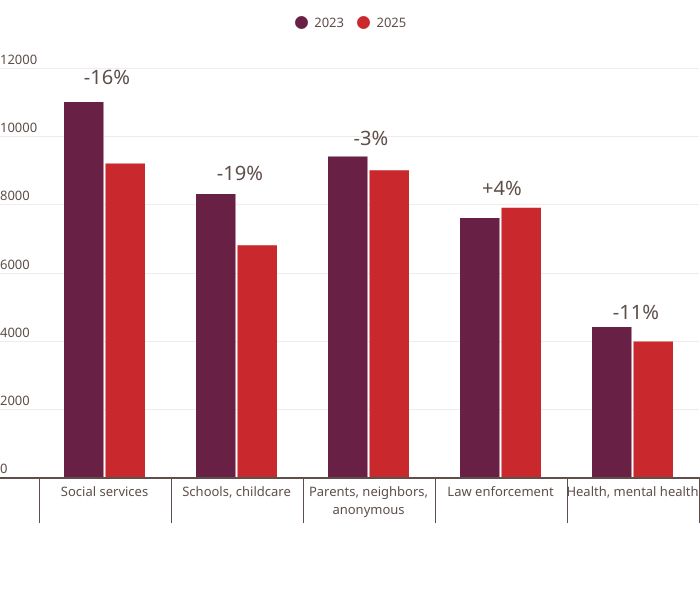
Recent data indicate that hotline reports (known in New York as Statewide Central Register reports) from the three primary sectors that ACS has engaged (social services, schools/childcare, and health/mental health) are going down. Hotline calls from these groups were down 16% in the first 34 weeks of 2025 when compared to the first 34 weeks of 2023. This equates to 3,770 fewer families reported. Additional research and evaluation efforts are needed to better understand the impacts of fewer reports and how the reduction in reports relates to indicators of child safety as well as the provision of family support.
New York Statewide Central Register Reports by Source,
2023 and 2025 (first 34 weeks of each year)
Other resources in this series
Casey Family Programs consults with individuals and teams across the country to compile research, experiences, and insights about approaches that can safely reduce the need for foster care and ensure the well-being of children and families. We share this information broadly to help child welfare leaders and their partners tackle similar issues in their own communities. For questions about this resource, or if you have other child welfare information needs, please email kmresources@casey.org.
1 The content of this brief was informed by materials shared during a December 2024 Casey Family Programs-sponsored convening in Austin, Texas, that focused on transforming mandated reporting, and interviews with New York City Administration for Children’s Services: Lisa Bolling, Assistant Commissioner, Family Services Division, on June 20, 2025, and Katherine Haver, Senior Advisor, on June 17, 2025. ↩︎
2 All data in this section provided by ACS in August 2025. ↩︎
3 New York State Office of Children and Family Services (OCFS) ↩︎