Since 2017, the number of children in foster care nationwide has been decreasing. In 2017, 426,800 children were in foster care and by 2024, the number had lowered to 315,400.1 This trend is encouraging because being separated from family for any length of time can have lasting consequences for children’s cognitive and emotional well-being. Removal and placement are sources of trauma. Instability due to family separation and placement in foster care is considered one of many Adverse Childhood Experiences (ACEs), which are linked to many long-term negative health outcomes and future loss of opportunity.
A 2025 study from the School of Criminal Justice at Rutgers University found that higher rates of foster care placements did not correlate with a decrease in child abuse- or neglect-related deaths, challenging assumptions that reducing foster care placements puts children at greater risk. It has been the aim of many child protection agencies to reduce the number of children in foster care by offering prevention services that strengthen families before a crisis arises, as well as by accelerating the time to permanency.
It’s not about chasing any one number. It’s about being intentional and making sure that our intervention matches what each family needs at that time.
While many jurisdictions have safely reduced their foster care populations between 2020 and 2024 (the national average has been a decrease of 21%), Casey Family Programs sought out six jurisdictions2 that have seen reductions during this period that were well above the national average in order to learn more about their strategies that have advanced their rates of reduction. Critically, these six jurisdictions did not lose sight of child safety — each achieved a high foster care reduction rate without experiencing an increase in repeat maltreatment, maintaining 12-month maltreatment recurrence rates lower than the national average of 9%.3
Reduction Rates for Children in Foster Care: 2020-2024
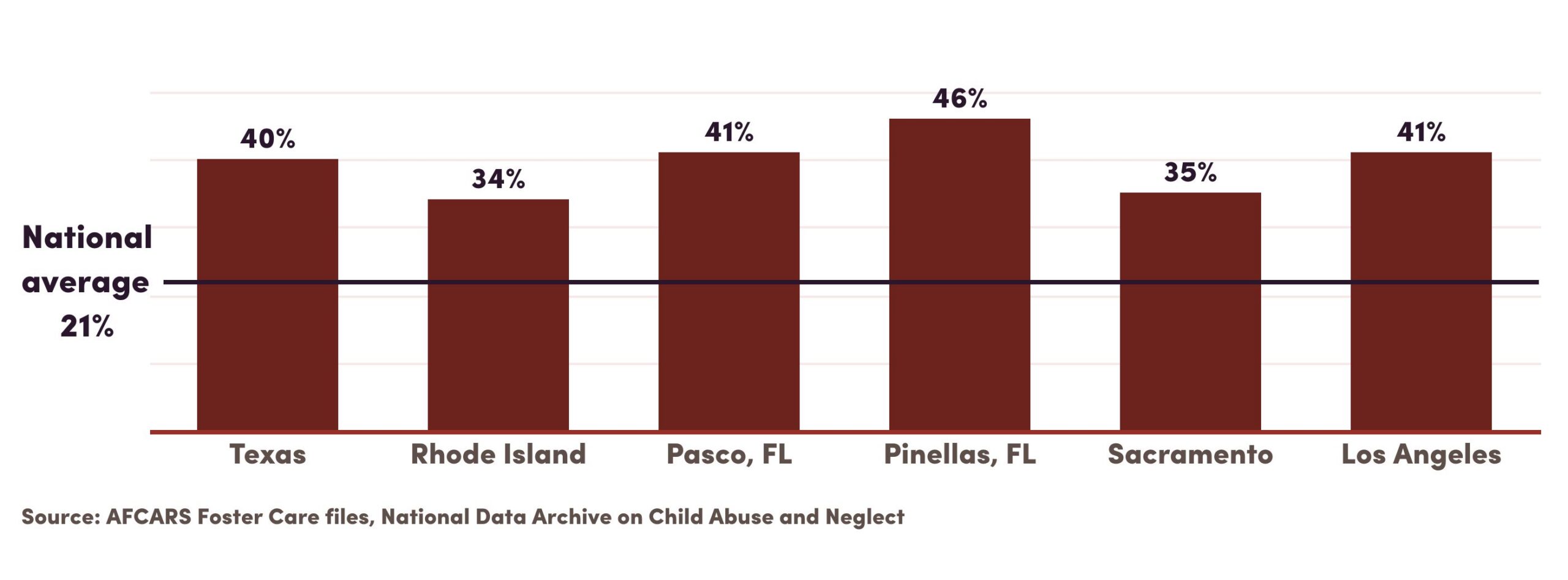
The jurisdictions interviewed for this brief include a mix of both states — Texas and Rhode Island — and counties — Pasco and Pinellas in Florida, and Sacramento and Los Angeles in California. No two systems followed the same path to reach these outcomes, and in each, the strategies employed were multifaceted and complex. Common themes emerged, however.
Change arises from a variety of circumstances
Our vision for children and families needs to be a shared vision with everyone who has power and authority relative to vulnerable families. We can’t do this alone.
Reducing the number of children in foster care was not the primary driver of systems change in any of the six jurisdictions. Instead, safe reduction was an outcome of other priorities including an increased focus on equity, bolstering parents’ rights, and high-quality practice. In some cases, crises attracted attention and critical resources that enabled systems to accelerate the pace of change.
- Texas. Policy changes at the Department of Family and Protective Services (DFPS) were necessitated by legislation in 2021 that lifted up the importance of parents’ rights and preventing the trauma of unnecessary family separation. Legislative changes prohibited non-emergency removals and narrowed the legal definition of neglect by excluding situations solely related to a family’s poverty or economic circumstances. These policies led to a precipitous drop in foster care entries from 2021 to 2022 and the decline has continued in the years since, amounting to 40% reduction from 2020 to 2024.
- Rhode Island. Changes leading to a 34% reduction in the foster care population followed the Department of Children, Youth & Families’ (DCYF) implementation in 2019 of a new practice model, Safety Assessment and Family Evaluation (SAFE). The goal was not to open fewer cases but to ensure they were opening cases for the right families by increasing equity and consistency of decision-making across units and staff.
- Pasco and Pinellas Counties. In these two adjacent counties along Florida’s Central Coast, a single community-based provider contracts with the state Department of Children and Families to serve as the lead child welfare agency for both. In 2021, a series of highly publicized serious injuries among youth staying in administrative offices and unlicensed settings cratered state legislators’ confidence in the former contractor. Lawmakers appointed a new lead agency, Family Support Services (FSS), through an emergency procurement in December of that year, and infused it with a significant amount of funding. Through a focus on culture change, appropriate front-end services, and rebuilding community trust and engagement, FSS has been able to reduce the number of children in foster care by more than 45% in the counties in just three years.
- Sacramento County. The prevention of child maltreatment has been a countywide focus for several decades, bolstered by the creation of a formal Prevention Cabinet in 2019. The county has also focused on improving permanency and reunification rates, illustrating that a reduction in foster care numbers is realized through addressing both the front end (prevention) and back end (permanency) of the child welfare system. System reforms — such as a focus on reducing racial disparities through its Black Child Legacy Campaign and expansion of an intensive case management program that allows families to remain home safely together with support — are also noted factors that have contributed to a longstanding steady downward trend, including a 35% decrease from 2020 to 2024.
- Los Angeles County. It’s difficult to pin the reduction in foster care to a single point of origin in a jurisdiction as large as Los Angeles County, where many child welfare innovations are in various phases of implementation throughout the system. But Department of Children and Family Services (DCFS) Director Brandon Nichols sees the lower volume of hotline calls during the COVID-19 pandemic as a factor in the county’s 41% decline between 2020 and 2024, as that allowed the agency to focus more time and resources on strategic planning. He also credits an emphasis on better social work practice, family and community engagement, and decision-making.
Clearly and consistently communicating core values
One of our guiding principles is that we start with what’s best for the child, and we work our way back from there.
Shared values and consistent reminders that child protection agency decisions are driven by what’s best for children and families are critical to keep advancing system improvement despite inevitable challenges.
- Pasco and Pinellas Counties. FSS’ first priority was to address a risk-averse culture that it felt had contributed to an overwhelmed system. The incoming leadership team immediately brought the staff it inherited from the predecessor lead agency up to speed about FSS’s guiding values, beliefs, and principles, which include prioritizing child well-being and ensuring that every decision is child-centered. Despite finding abysmal levels of only 25% to 35% of case management positions filled when it took over, with caseloads peaking at 50 children or more, FSS did not hesitate to part ways with staff whose values did not align.
- Rhode Island. Brandi DiDino, DCYF deputy director, cites the importance of consistently reinforcing the why behind departmental decisions, especially to supervisors and administrators: “It’s not just because we are telling them to do something, it’s because it is the right thing for families.”
- Los Angeles County. The message from Nichols to his staff at DCFS has been similar: “We’re doing this because we believe in it, and we know it’s going to work.” Nichols’ 30-year tenure with the county and his durable relationships with key members of his leadership team no doubt have given additional credibility to his messaging and approach.
Narrowing the front door through policy change
Our prevention efforts haven’t been just one thing. At the core is determining: Has a parent directly harmed this child, or are there other factors, lack of resources, or racism involved?
In several jurisdictions that have achieved safe reduction, a founded or substantiated incident of maltreatment does not necessarily require removal, if appropriate (and sometimes intensive) supports can keep the child safely at home.
- Rhode Island. The state’s SAFE model employs a family functioning assessment to better understand not only the incident of alleged maltreatment, but how the family typically operates. This assessment helps DCYF better determine whether a family needs ongoing government support. If the answer is yes, the agency uses specific criteria to determine whether a safety plan can be developed to keep the child in the home. For those families that can be safely supported without separating, DCYF policy does not require court involvement. This less intrusive approach is believed to reduce trauma for the family.
- Sacramento County. Safety Organized Practice is a tool the county uses along the entire continuum of child welfare decision-making to help caseworkers address bias and distinguish valid safety concerns from “worries.” In high-risk cases when families are highly motivated to engage in services, Sacramento’s intensive case management program can help families stay safely together while they heal.
- Texas. One way DFPS ensured that the legislated changes focused on keeping families together didn’t compromise child safety was to expand use of alternative response in low-risk cases, ensuring that families that do not require removal still have access to the supports they need.
Leveraging family and community supports
Child Protective Services alone can’t protect every child in the community. That’s why community involvement is so important.
Child protective services cannot — and should not — be solely responsible for meeting families’ needs to keep children safe. One principle behind the legislated changes in Texas was that the child protection agency should not be a family’s ongoing service provider. “We should be in and out of a family’s life quickly,” said Stephanie Muth, former DFPS commissioner who was elevated to executive commissioner of Texas Health and Human Services in January 2026.
- Sacramento County. The child protection agency relies on its extensive network of community partners to help support families, contracting with organizations that are able to provide basic needs to families experiencing a one-time crisis. The agency also pays for court-mandated community services, which helps eliminate barriers to safe reunification. Unlike the preferred quick-exit model in Texas, Sacramento’s child welfare system often stays connected with families for as long as six months after reunification to help families further stabilize, in part by linking them with community supports.
- Pasco and Pinellas Counties. FSS leans in heavily on families’ natural supports. “A caseworker can’t be there seven days a week,” President and CEO Jenn Petion said. The strategy includes leveraging the help of kin and neighbors to keep children safe, recognizing that these natural supports will remain in the lives of the families long after their case with the agency is closed.
- Los Angeles County. Since 2021, California’s Family First Prevention Services has provided flexible funding to contract with community partners for additional upstream services. The county also places a strong emphasis on kinship care, with regional offices placing children with kin at rates as high as 90%. Nichols believes that in addition to reducing trauma for children, placement with kin also can accelerate the path to reunification or other forms of permanency.
Right-sizing services to needs
We might need fewer providers, but we need them to provide the right services. Our new rate structure incentivizes the least restrictive setting for the needs of each individual child.
Cost savings never should be an incentive for wanting to reduce the foster care population — child safety and well-being is the sole driver. Cost savings, however, may result from policies that inspire reduction. Rather than developing strategies to decrease the costs of maintaining children in foster care, jurisdictions focus on providing the most appropriate services to effectively meet the needs of each child and family. This exercise of right-sizing services not only benefits children and families, but it also allows child protection agencies to use their limited resources more efficiently.
- Texas. As the number of children in foster care decreased, the state saw significant shifts in the needs of the children still in the system. Texas Child-Centered Care created a new methodology for paying for foster care, basing rate packages on individualized assessments of children’s needs. The resulting rates are higher than under the previous system — and so are the expectations for quality services and positive outcomes.
- Pasco and Pinellas Counties. Soon after FSS assumed the role of lead agency, its commissioned analysis found an array of existing services available to children and families. The challenge, Petion said, was “they weren’t putting the right intervention level to the right kids.” By building up services where gaps existed, the counties quickly saw programs being more readily accessed and effective. In addition, offering more services appropriate to the needs of lower-risk families freed up program space for higher-risk families to get the more intensive help they needed to stay safely together or reunite.
Building trust through transparency
Once you have the community’s trust, they will come to the table and help you do more innovative things for kids and families.
Transparency with stakeholders, from community members to judges and legislators, was a common approach in jurisdictions achieving successful and safe reduction.
- Los Angeles County. DCFS Director Nichols spends time in local churches, talking with caregivers, and meeting with families involved in the child welfare system, including some whose children died while under DCFS supervision. He encourages his staff to do the same. He has also established managerial positions dedicated to maintaining consistent engagement with the LGBTQ+ and faith-based communities, as well as communities of color. DCFS regularly invites community representatives to child and family team meetings, including department-paid cultural brokers who are trained to help build trusting relationships between Black families and DCFS. Nichols believes that this practice, which began as part of the department’s Eliminating Racial Disproportionality and Disparity initiative, serves to balance power dynamics and help social workers make better decisions.
- Pasco and Pinellas Counties. Judges were so frustrated by the previous lead agency that they initially refused to meet with the new leadership of FSS. In response, FSS shared its progress — as well as its ongoing challenges — through bi-weekly email updates. FSS also placed dedicated liaisons in courtrooms to help prep caseworkers and ensure follow-through. Once judges interpreted that FSS was serious about making real change, the relationship improved.
- Texas. Judges also have been a key partner in Texas, largely through participation in the Supreme Court’s Texas Children’s Commission. During her tenure as DFPS commissioner, Muth invested in efforts to change the narrative about child welfare in her state, using data to tell a new story. “We’re judged so much on the anecdotes, on one case that the Legislature gets a complaint about,” Muth said. “Offering a counter-picture of how we’re doing was important.”
- Rhode Island. After conducting an extensive listening tour with staff, families, and youth in 2023, DCYF has created a Child Well-Being Advisory Committee, which engages diverse community members with child welfare experience in strategic planning and implementation across the agency. Community members and professionals serve together on subcommittees based on their individual interests rather than being restricted to a designated ‘community subcommittee’. “We should make informed decisions,” Deputy Director DiDino said. “That means information from everybody.”
Recruiting and retaining the right staff
While we have fewer kids in foster care, we still have a growing population in Texas and a significant number of investigations. We have been able to reduce caseloads across the board by transferring resources.
When foster care numbers decline, decision-makers may assume that child protection agencies in turn can reduce staff — but that is not necessarily the case. As lower-risk cases are managed inside the family home, the composition and acuity of out-of-home cases may require smaller caseloads. Maintaining staffing levels as their in-care populations declined has allowed jurisdictions to shift their practice and resources strategically, resulting in a “snowball effect” that leveraged small initial wins into systemwide transformation. “Each case we’re able to remove from a worker’s caseload gives that worker more time to do better social work with the rest of their families. More time with families leads to better decisions, safer children, and, ultimately, fewer kids in care,” says Nichols.
- Pasco and Pinellas Counties. FSS engaged local media to change the community’s view of child welfare and invite prospective staff to consider joining the agency with the message: “It’s a new day in child welfare.” This positive framing, along with a significant increase in starting compensation for staff, quickly attracted the right hires, and has led to more sustainable staffing levels and an engaged team ready to work toward achieving shared goals.
- Rhode Island. To help DCYF attract a diverse workforce, it increased the frequency of its civil service exam to once a month (it had been offered once a year or less). The exam also is offered different times throughout the day to offer convenience to people unable to take time away from their current jobs. Under these recruitment efforts, which also benefit current staff, DCYF’s Family Service Division has experienced staff vacancies in the single digits.
Monitoring data and adjusting strategy
We watch the numbers on safety metrics, recurrence of maltreatment, and re-entry into care very closely. If we ever see an uptick, it’s a very big deal and we take a close look at why it’s happening.
Carefully monitoring data is a key strategy for jurisdictions that are reducing their foster care numbers. Data offer vital information to ensure child safety is not being compromised as a result of reduction strategies while helping guide other system improvements.
- Pasco and Pinellas Counties. FSS uses data to identify families well-positioned for fast, safe exits from the system. They prioritized cases that either had strong stability or a longer length of stay. FSS credits the drop in the number of foster care placements not only to a decreased child removal rate, but also to an increase in the percentage of children achieving permanency within 12 months.
- Rhode Island. DCYF leaders have access to a strategic dashboard that is updated monthly. “We need data systems talking to each other. Technology should help us do our job,” says DiDino.
- Texas. Muth emphasizes the importance of regularly reviewing data both in aggregate and at the case level to ensure policies are being followed without creating unintended consequences.
- Los Angeles County. DCFS regularly monitors safety data and is exploring data models that may help the county better identify families that need the highest levels of engagement and those more likely to fare well with fewer services.
- Sacramento County. Data is analyzed by ZIP code, with an emphasis on seven communities that collectively span nearly 16 ZIP codes and that are part of the county’s Black Child Legacy campaign.
While the need for foster care still exists, these jurisdictions have shown that serving more families upstream, implementing policies and tools that address system and individual bias, and leveraging community-based resources to support families at home can result in significant reductions in the number of children in foster care without compromising child safety. While the strategies have reduced foster care rates among all racial and ethnic groups, Black and multiracial children in these jurisdictions tend to still be overrepresented in foster care. Targeted strategies are necessary to address racial disparities that persist despite child welfare system improvement efforts.
Casey Family Programs consults with individuals and teams across the country to compile research, experiences, and insights about approaches that can safely reduce the need for foster care and ensure the well-being of children and families. We share this information broadly to help child welfare leaders and their partners tackle similar issues in their own communities. For questions about this resource, or if you have other child welfare information needs, please email kmresources@casey.org.
1 Data are for children under age 18 and are rounded to the nearest hundred. Data in this brief come from U.S. Department of Health and Human Services, Administration for Children and Families, Children’s Bureau. Available from the National Data Archive on Child Abuse and Neglect, AFCARS Dataset. The receiver of the original data (the Archive, Cornell University) bears no responsibility for the analyses or interpretations presented here. ↩︎
2 Content of this brief was informed by interviews with Stephanie Muth, then-Commissioner, Texas Department of Family and Protective Services, on July 16, 2025; Jenn Petion, President and CEO, and Carlos Cruz, Chief of Staff, Family Support Services, on July 17, 2025; Brandon Nichols, Director, and Amoreena Jaffe, Deputy Director, Los Angeles County Department of Children and Family Services, on August 4, 2025; Melissa Lloyd, Deputy Director of Child Protective Services, Sacramento County Child, Family and Adult Services, on September 12, 2025; and Brandi DiDino, Deputy Director, and Barbara Francella, Public Information Officer, Rhode Island Department of Children, Youth and Families, on September 30, 2025. ↩︎
3 Recurrence of maltreatment is defined as victims of a substantiated report of child abuse or neglect during a 12-month period and who experienced another substantiated report within 12 months of the initial report. ↩︎